White paper
Continuous Direct Compression: from regulatory evolution to real-world implementation.
-
Reading time 13 min
-
A study by
Introduction
Continuous Manufacturing has been studied, approved, harmonised and actively recommended by regulators for the better part of two decades. Despite this, most tablets are still made in batches. The gap between what is permitted and what is practised is one of the most persistent anomalies in pharmaceutical production — and it is rarely technological. Continuous Direct Compression (CDC) is the most direct of the continuous routes. Instead of dispensing, blending and compressing as three separate operations, each with its own intermediate storage, transfer and testing step, a CDC line meters every ingredient continuously into a mixer and feeds the resulting blend straight to the tablet press, in a single, uninterrupted flow. Fewer handling steps, a shorter path from raw material to tablet, and a process that can be observed while it runs rather than judged after it has stopped. This article explores how Continuous Direct Compression can be effectively implemented in today’s industrial context. It reviews the regulatory evolution, the shift in quality mindset, the tangible benefits of a continuous process, and the architectural and control principles that enable reliable operation. Finally, it highlights how IMA’s streamlined approach, culminating in the DOMINA tablet press as the final verification node, translates continuous processing from theory to practical, scalable reality.
The regulatory landscape: a modern framework supporting Continuous Manufacturing
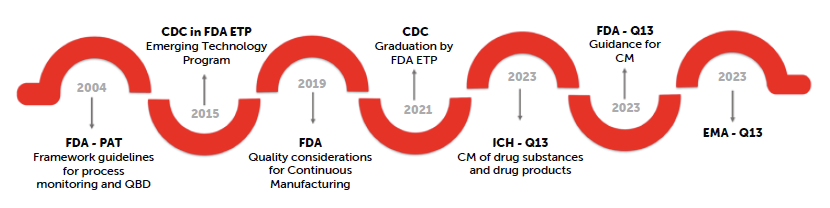
Although cultural barriers still slow down adoption in many pharmaceutical companies, the regulatory framework for Continuous Manufacturing has eventually been published, and specifically the Continuous Direct Compression, is today consolidated. Over the last two decades, regulators have progressively shaped a structured path that brings Continuous Manufacturing from emerging to a recognised, harmonised and recommended technology. A chronological view helps clarify why awareness inside companies is now essential:
• 2004 – FDA PAT Framework
The FDA introduces the Process Analytical Technology (PAT) Framework, marking the first major regulatory shift toward real-time process understanding and real-time quality assurance, helping the pharmaceutical industry address anticipated technical and regulatory issues and questions. [1]
• 2015 – First acceptance of CDC into the ETP
CDC is formally accepted into the FDA Emerging Technology Program (ETP), a framework established to help companies discuss and resolve technical and regulatory challenges related to innovative manufacturing technologies.
This acceptance allows sponsors to engage directly with the FDA to address scientific and regulatory questions early in development. [2]
• 2019 – FDA Quality considerations for Continuous Manufacturingdraft guidance
The FDA published the draft guidance Quality Considerations for Continuous Manufacturing (now replaced with ICH Q13), outlining the Agency’s thinking on the key quality aspects of Continuous Manufacturing for small-molecule, solid oral drug products.
The document provided recommendations on process dynamics, control strategy, input material controls, process monitoring and material diversion, offering a clear regulatory framework for how applicants should address Continuous Manufacturing within NDAs and ANDAs.
• 2021 – Graduation of CDC from the FDA Emerging Technology Program (ETP)
Continuous Direct Compression becomes the first technology to graduate from the FDA Emerging Technology Program, marking the Agency’s confidence that CDC can be reviewed through the standard OPQ quality assessment pathway. This milestone reflects years of collaboration between the FDA and CDC sponsors, during which the Emerging Technology Team developed internal expertise and trained reviewers to support broader industrial adoption. [3]
• 2023 – FDA issues Q13 guidance for Continuous Manufacturing
The FDA aligns its regulatory framework with the international ICH Q13 guideline, reinforcing expectations on Continuous Manufacturing and providing a harmonised basis for implementing Continuous Manufacturing across drug substances and drug products. [4]
• 2023 – ICH Q13 becomes the global reference framework for Continuous Manufacturing
ICH publishes the harmonised Q13 guideline covering Continuous Manufacturing for drug substances and drug products, defining principles for integrated systems, material diversion, real-time monitoring and control strategy. [5]
• 2023 – EMA adopts and implements ICH Q13
The EMA fully adopts the ICH Q13 guideline, ensuring regulatory alignment across major agencies and simplifying global development and submission strategies for companies adopting Continuous Manufacturing. [6]
The benefits of Continuous Direct Compression (CDC)
CDC delivers a broad set of advantages that extend across quality, efficiency, safety, flexibility and sustainability. These benefits, highlighted in the Continuous Manufacturing framework, reflect the intrinsic strengths of a streamlined, integrated and highly automated process.
Quality and safety
CDC reduces the risk of human error through a high degree of automation and continuous monitoring. The integration of PAT enables continuous in-line measurement and real-time release testing, supporting consistent product quality. Reduced material handling further enhances operator and product safety.
Flexibility and efficiency
CDC systems are compact, modular and designed for rapid tech transfer and scale up. Batch size and production volume are defined by runtime, replacing equipment scale-up with run time as the scaling variable. Productivity increases through shorter production time, reduced waste and minimised downtime.
Cost reduction and sustainability
Improved yields, fewer intermediate steps and smaller equipment footprints translate into lower operational and validation costs. Reduced utility consumption, minimised material usage, and lower cleaning requirements contribute to a lower environmental footprint. Continuous flow also mitigates the risk of drug shortages by shortening time to market and supporting more resilient supply chains.
A shift in quality philosophy: from testing to design
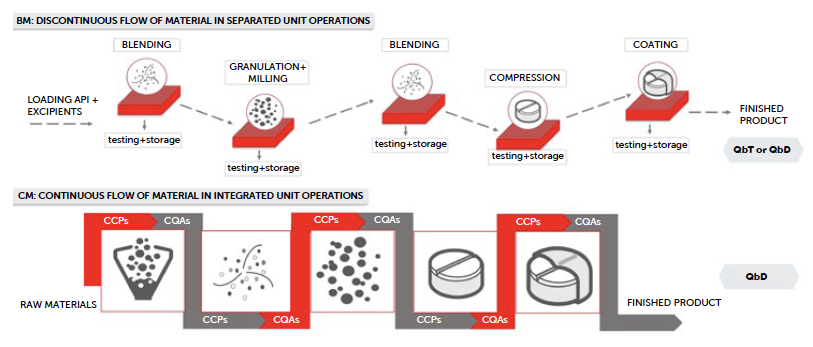
Continuous Direct Compression offers clear advantages, greater material efficiency, reduced waste, higher product consistency and faster reaction to process deviations. CDC, by its very nature, cannot rely on traditional Quality by Testing (QbT) logic. In a CDC process the flow of material is constant, rapid and uninterrupted; there is no practical margin to stop the process, waiting for an offline analytical result. For this reason, continuous processes require an approach based on continuity of control, real-time quality assurance and data-driven control rooted in Quality by Design (QbD, described in ICH Q8(R2). Quality must be engineered upstream, through the definition of critical parameters, a robust understanding of process behaviour and the design of a control strategy capable of maintaining the system in a stable “state of control” once steady-state conditions are reached.
Making CDC accessible to real-world pharma
While many existing Continuous Manufacturing systems available on the market were originally conceived for research environments, often requiring highly specialised staff, complex analytical infrastructures and dedicated laboratories, the approach adopted by IMA follows a different philosophy. This vision stems from a clear industry observation: despite two decades of regulatory progress and technological maturity, the practical adoption of Continuous Manufacturing remains limited because it is perceived as too complex, too delicate or simply incompatible with the current organisation.
The goal is to bring Continuous Direct Compression into real production departments. In practice, adopting CDC, especially in case of large production throughput requires rethinking how materials enter and move through the plant, how operators interact with equipment, how quality decisions are made and how data are interpreted. For companies built around batch logic, the shift demands coordinated changes in process design, competencies, workflow and regulatory confidence. Without structured guidance, the transition can appear complex, yet it represents the necessary evolution to unlock the full value of CDC technology.
A simple and flexible architecture
IMA’s CDC solution is deliberately designed to be simple, flexible and operator-friendly. No laboratory-grade analytical infrastructure is required around the line: the analytical capability is built into the equipment itself, with an architecture that focuses on robustness, predictability and ease of operation.
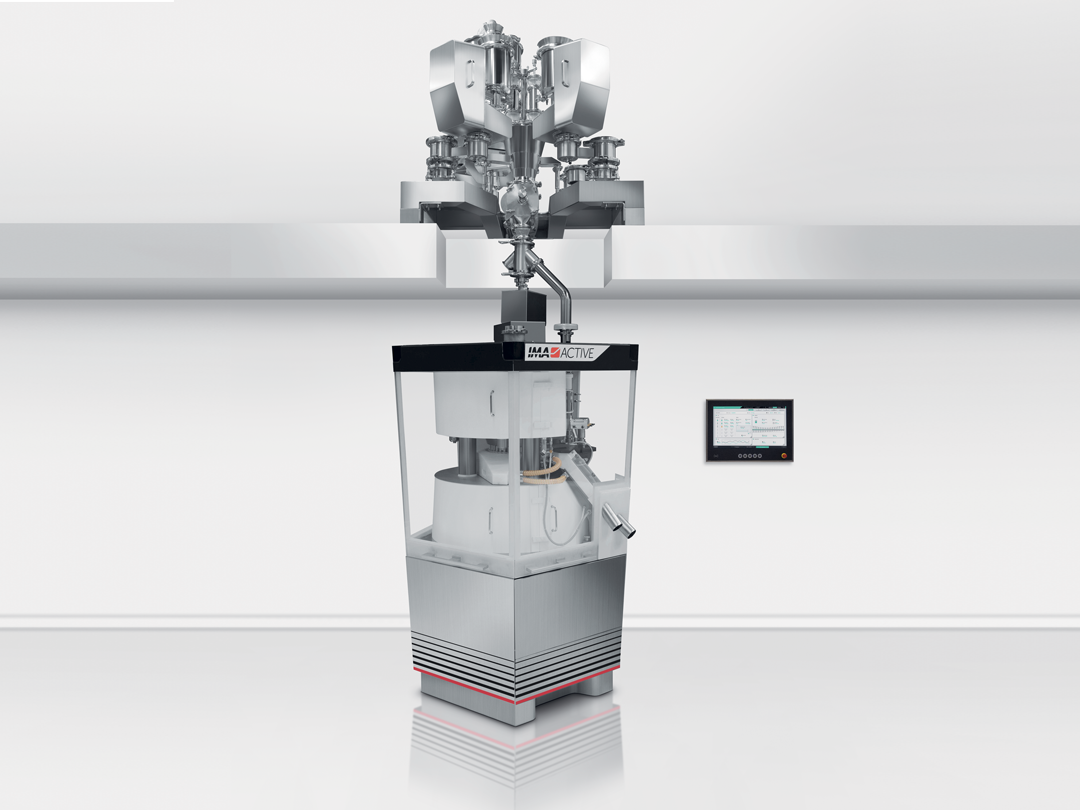
The system is composed of modular, well-understood unit operations – dosing, mixing and compression – coordinated through a supervisory control layer.
Each machine maintains its own control logic, but a higher-level platform orchestrates their work, ensuring material balance and stability across the entire line. This philosophy aligns with the idea that CDC must become an industrial tool, not a laboratory exercise. For this reason, the CDC architecture is engineered to
be inherently adaptable: the same core system can be configured for facilities with existing bins, multi floor layouts, limited headroom, or specific hygiene and operator exposure constraints. Instead of forcing a fixed design, the platform adjusts to the customer’s context. This adaptability is essential in today’s industry, where companies often adopt Continuous Manufacturing progressively rather than through a full plant redesign. By combining modular equipment, flexible installation options and multiple cleaning approaches, IMA ensures that CDC remains accessible, practical and fully compatible with real world production needs.
MAESTRO: orchestrating the process
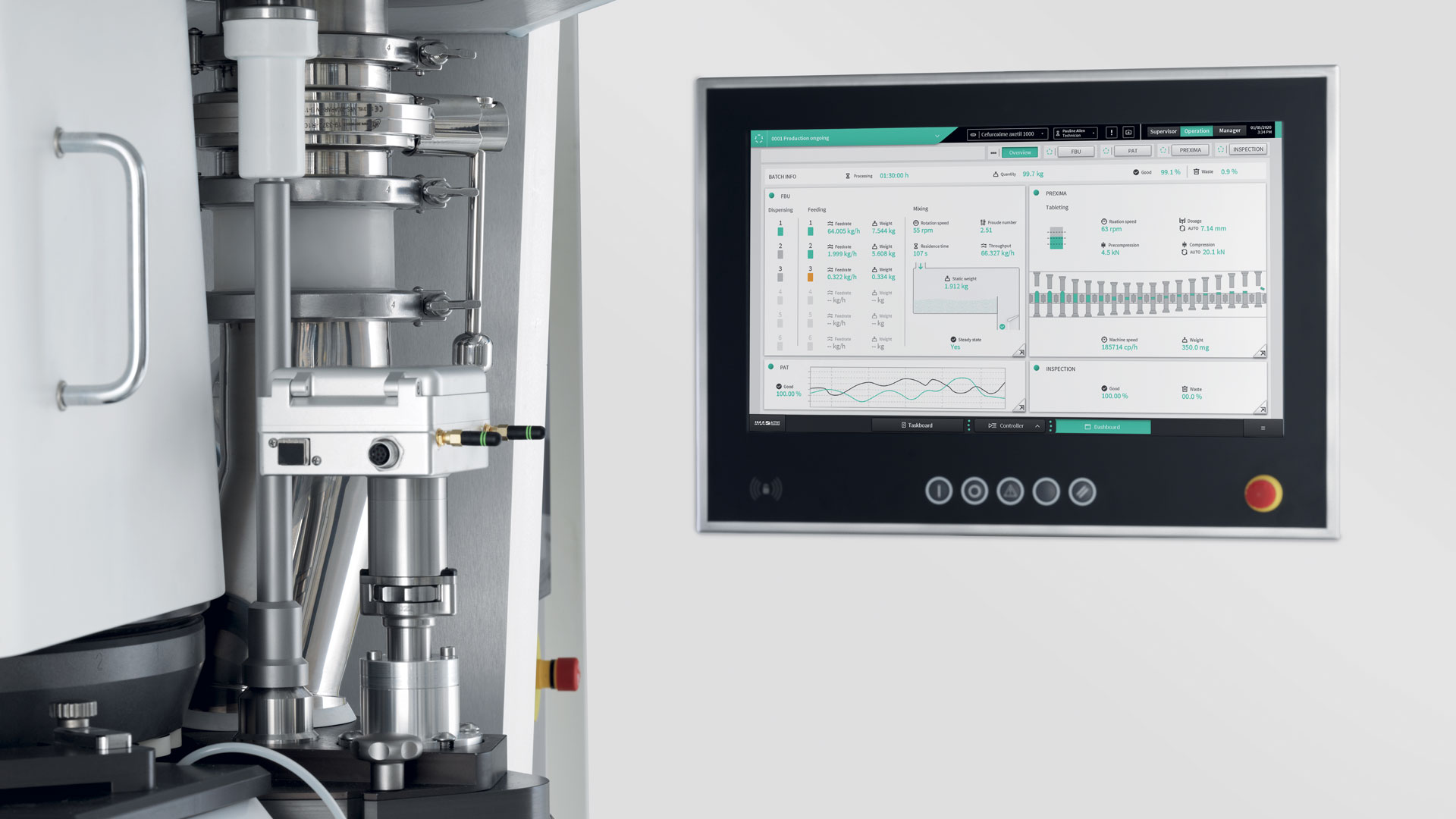
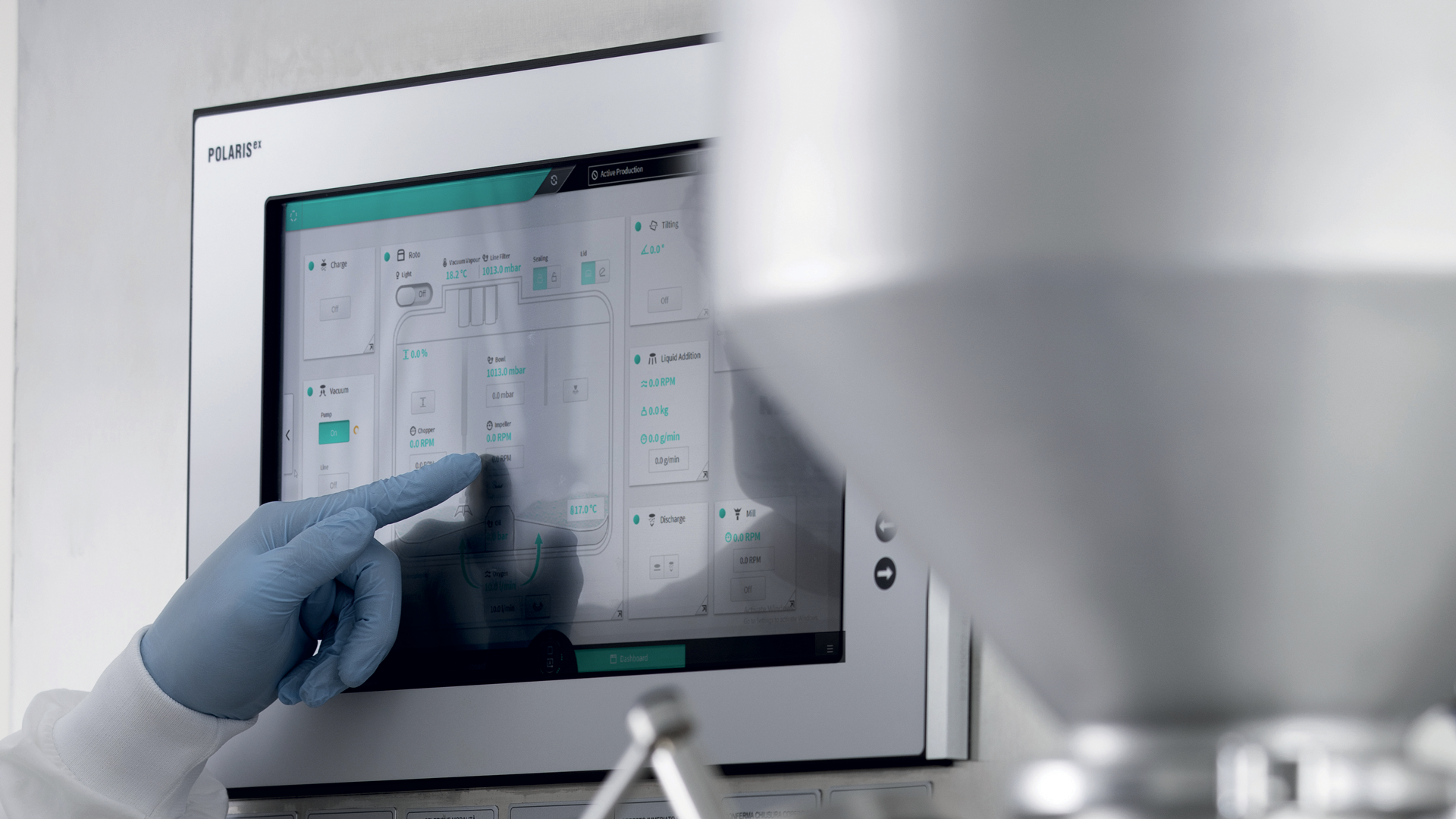
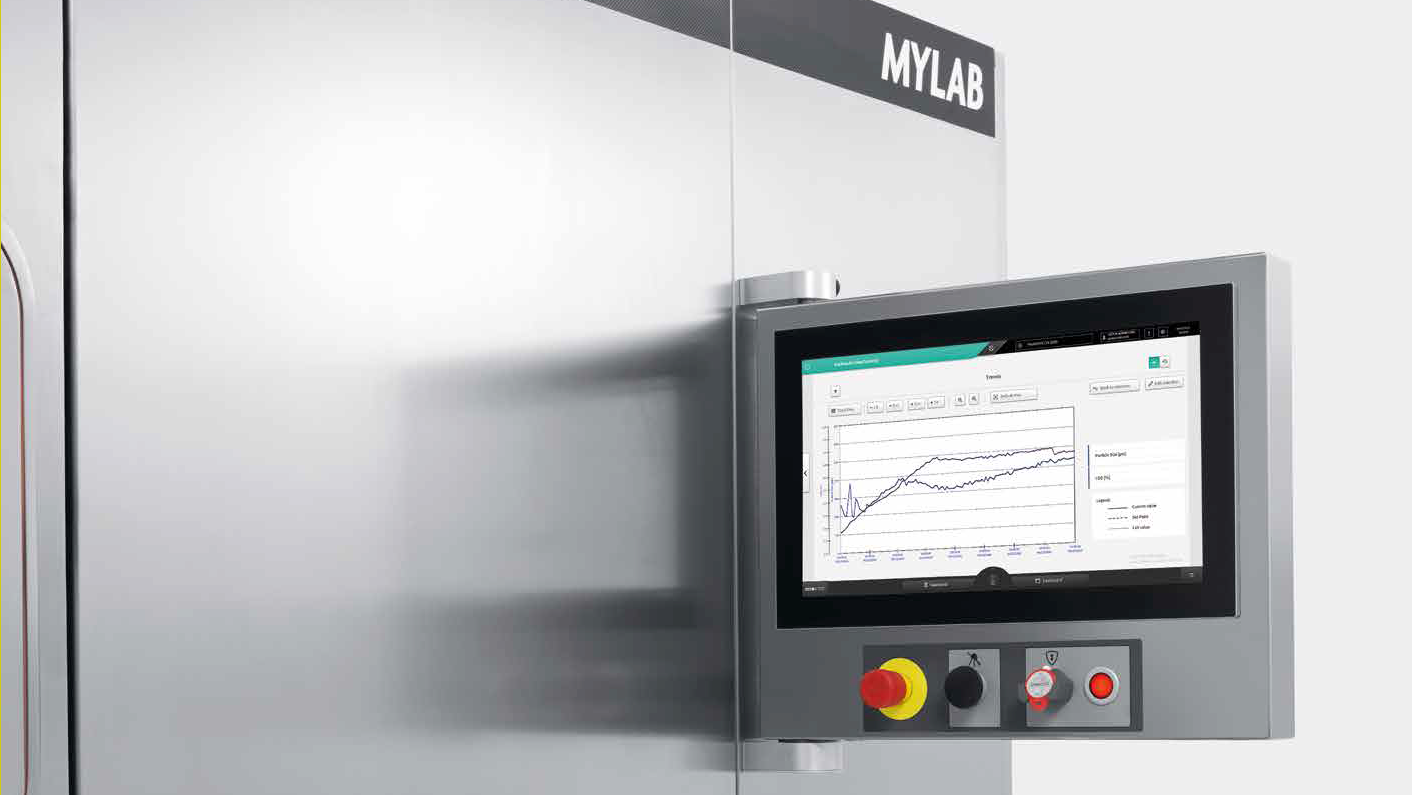
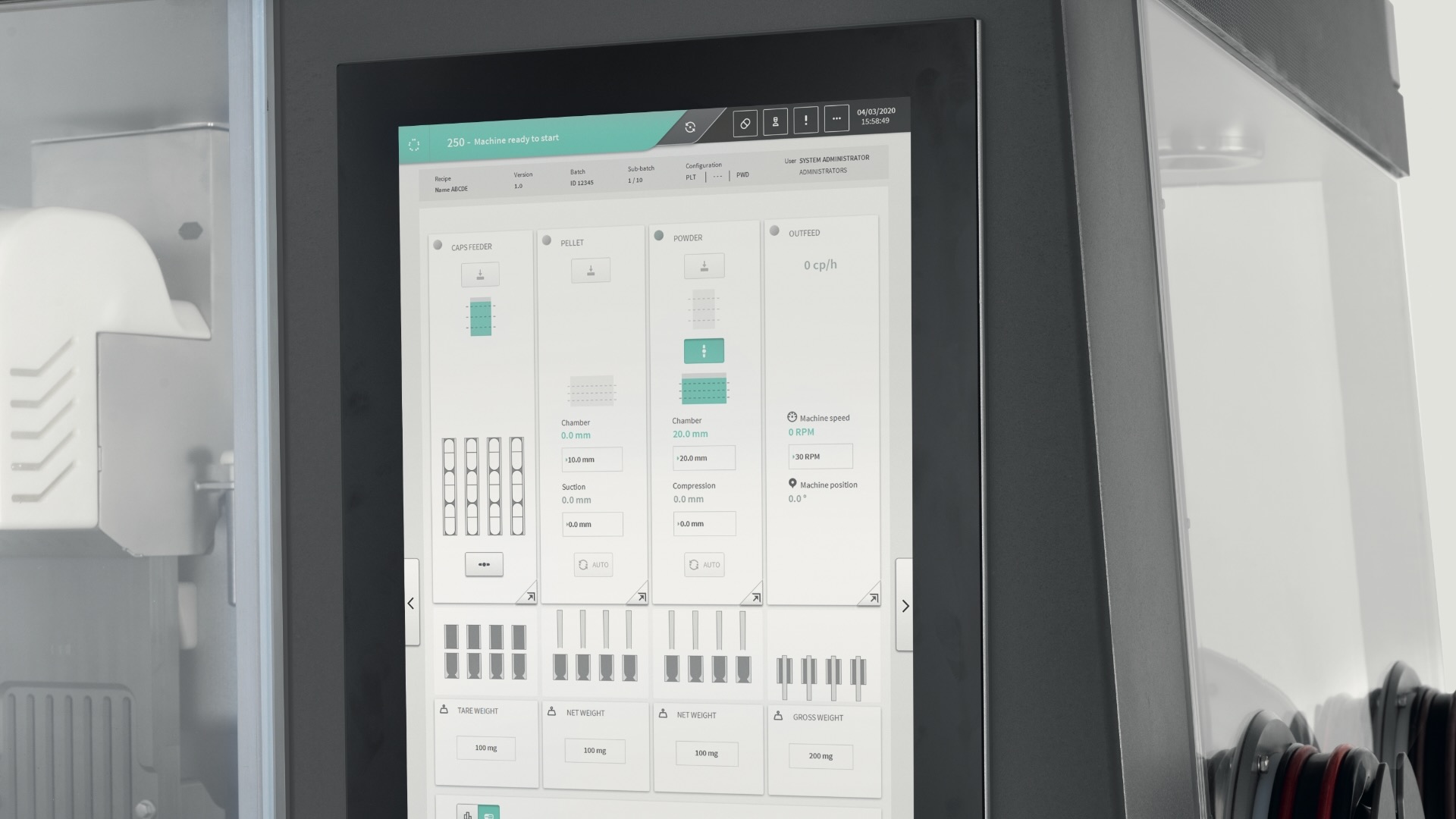
The more intuitive the CDC line, the easier it is for operators, supervisors and maintenance teams to adopt and master it. Central to this approach is MAESTRO, IMA’s integrated control system. Positioned above individual unit operations, MAESTRO coordinates dosing, blending and compression by providing unified supervision, real-time data visibility and consistent process logic across the full line. It acts like the conductor of an orchestra: each machine performs its function independently, but MAESTRO harmonises their actions to maintain stable material flow, ensure steady-state operation and support rapid detection of deviations.
This system directly addresses the need for a new way of monitoring processes in real time.
The goal is to maintain consistent product quality, manage material variability, and minimise waste. In the unlikely event that waste is needed, MAESTRO can operate material diversion of a minimum number of tablets, making it possible to preserve the rest of the run. MAESTRO simplifies complex information, tailors the interface to user roles, and makes continuous control accessible even to operators with standard training, without compromising technical depth.
Process control: the core of Continuous Manufacturing
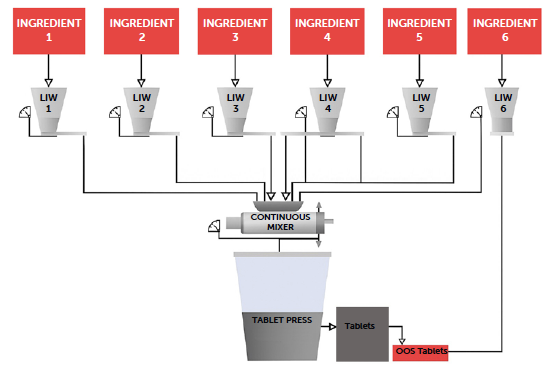
Once the system is harmonised through MAESTRO, the unified supervisory structure, the logic of process control emerges naturally. In a continuous environment, feeders, mixer and tablet press must not only perform their functions accurately, but must work as a combined system. It is this integration that turns multiple incoming ingredients into a stable, repeatable and tightly controlled workflow. Whether the formulation requires four, six or even seven ingredients, sometimes delivered individually, sometimes pre-mixed or granulated in batch steps, the system converges toward one primary requirement: to maintain a stable, predictable and measurable material flow from the moment the powders enter the line to the instant they are compressed into tablets.
To achieve this, the CDC architecture relies on three control steps based on each unit operation, each one contributing to a stable state of control:
• Ingredient dosing
Each ingredient is assigned to a proper size and configuration of LIW (Loss In Weight) feeder, which continuously controls the weight loss and transports the powder. This ensures that the correct proportion of each raw material enters the line from the very beginning, an essential condition for maintaining upstream balance and downstream stability.
• Blending under steady-state conditions
The second control step is located at the continuous mixer, which is also mounted on load cells. The mixer must maintain a stable mass hold-up. The total amount of material inside the chamber is determined by the equilibrium among several factors, including material rheology, blending tool speed, overall flow rate, and the composition of each formulation component, to cite only the most influential ones. A stable weight confirms that the line is in balance in terms of quantity. This condition represents the system’s steady state, the point at which the line achieves maximum predictability and process stability.
• Compression control, weight monitoring and NIR
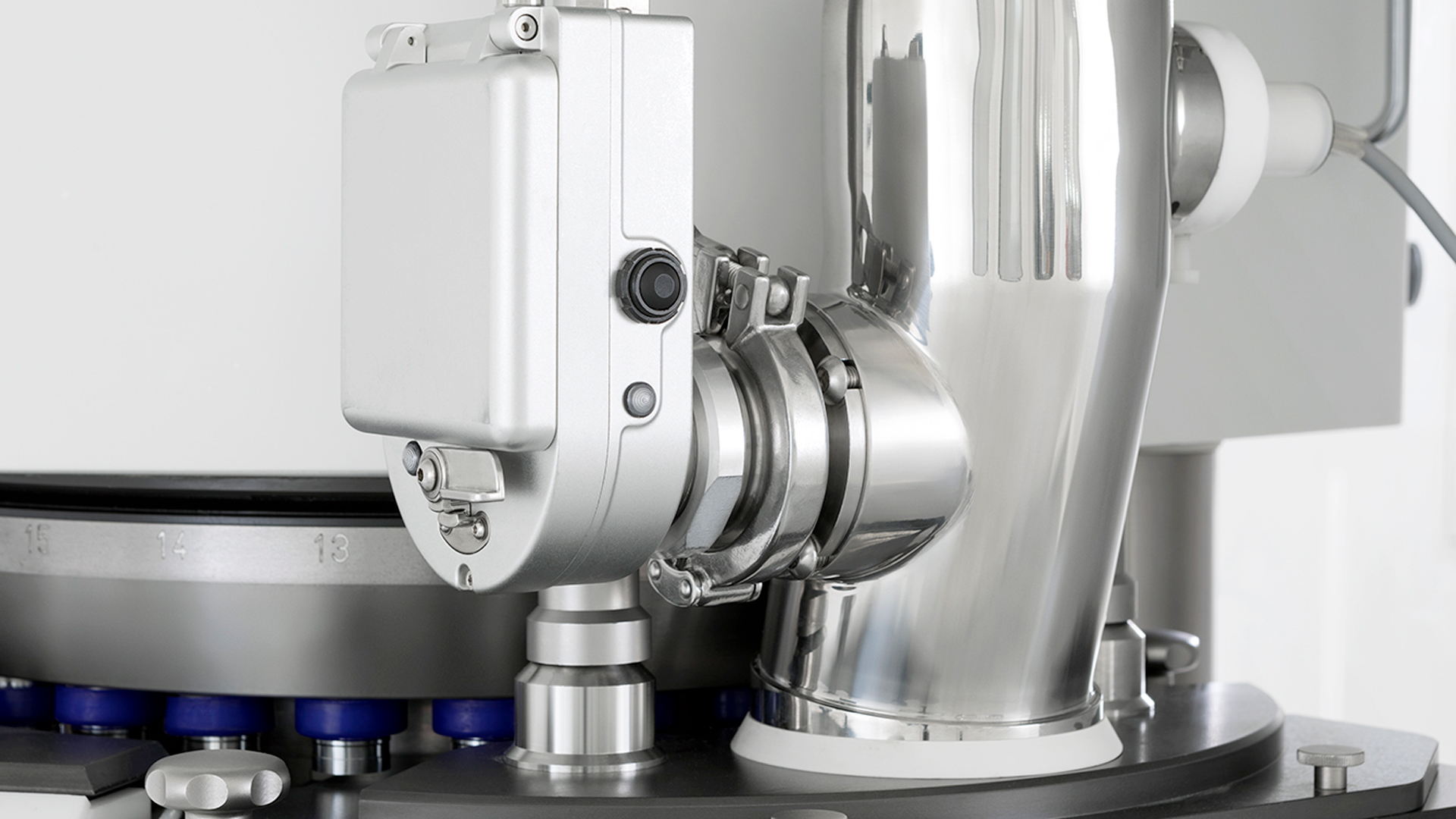
At the tablet press, traditional controls such as weight and compression force are complemented by an in-process NIR sensor placed at the feed frame. The NIR instrument measures chemical information in real time and provides an additional layer of information beyond mechanical parameters.
This real-time reading is combined with weight-based controls, enabling the system to confirm whether the material entering each die is within the acceptable range defined during development. Based on these measurements, the press can automatically divert any tablet that does not meet the acceptance criteria established during development. Because continuous processes evolve rapidly and offer little opportunity for offline adjustments, this targeted rejection acts as a protective mechanism, ensuring quality without interrupting the flow. In batch manufacturing, rejection is typically seen as a failure: if a laboratory test reveals non-compliance, the entire lot may be lost. In Continuous Manufacturing, this logic is inverted. Because the process moves quickly and does not allow
for pause-and-adjust interventions, targeted rejection becomes a deliberate protection mechanism, ensuring that the system isolates non-conforming material while maintaining the continuity of operation. Far from being a loss, this selective rejection is a key element of process robustness and a fundamental shift in mindset when transitioning from batch to continuous.
DOMINA perspective: where continuous meets tablet press excellence
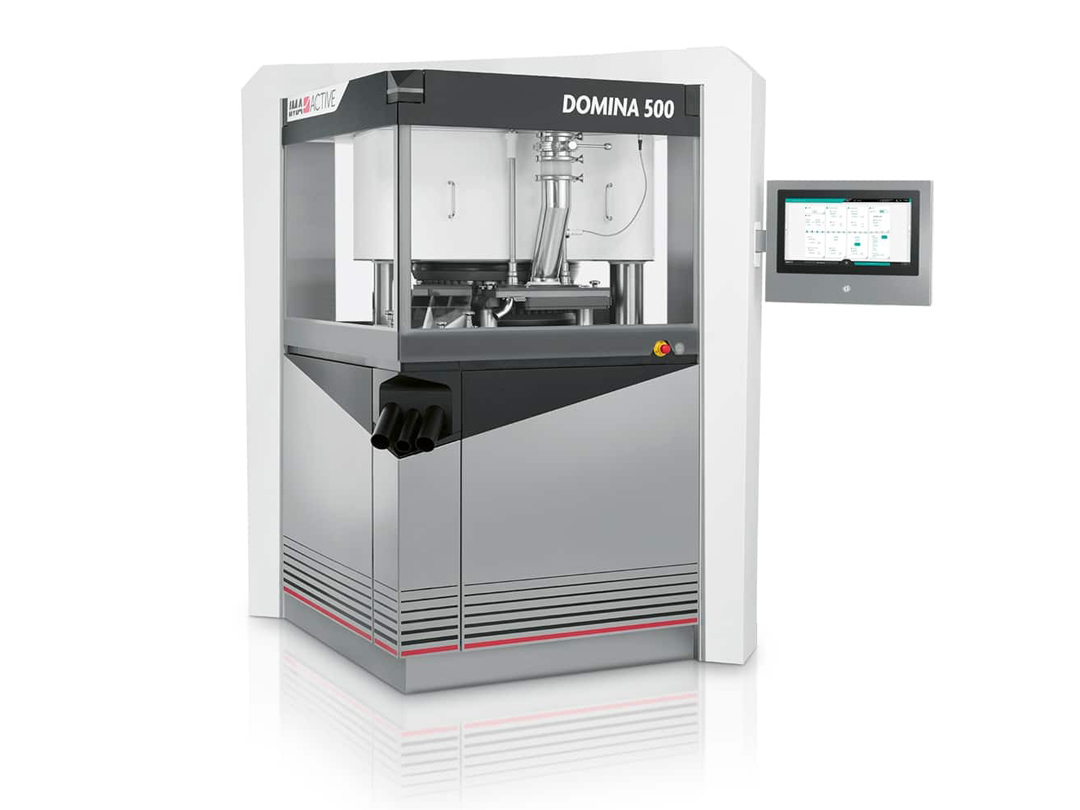
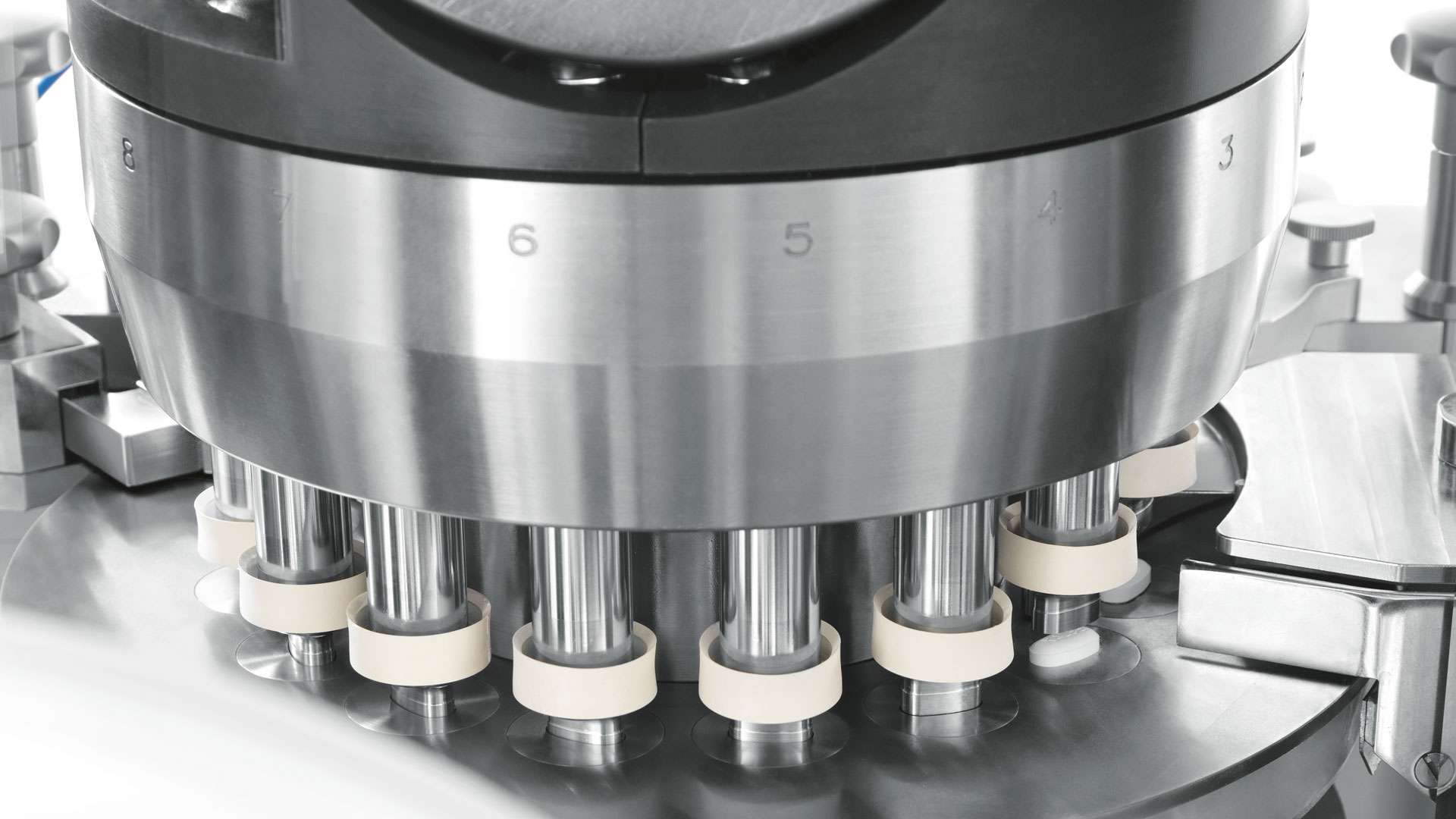
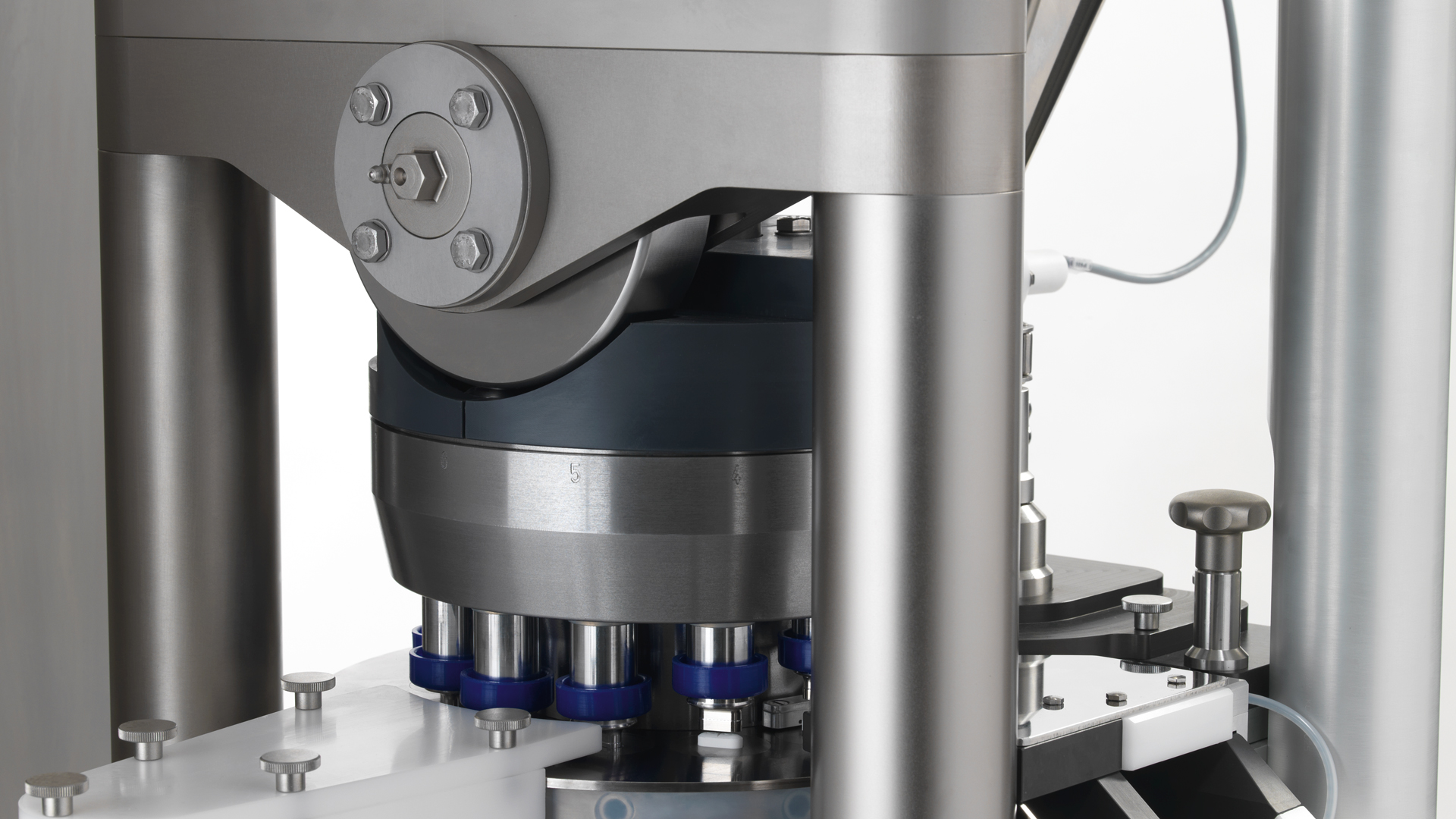
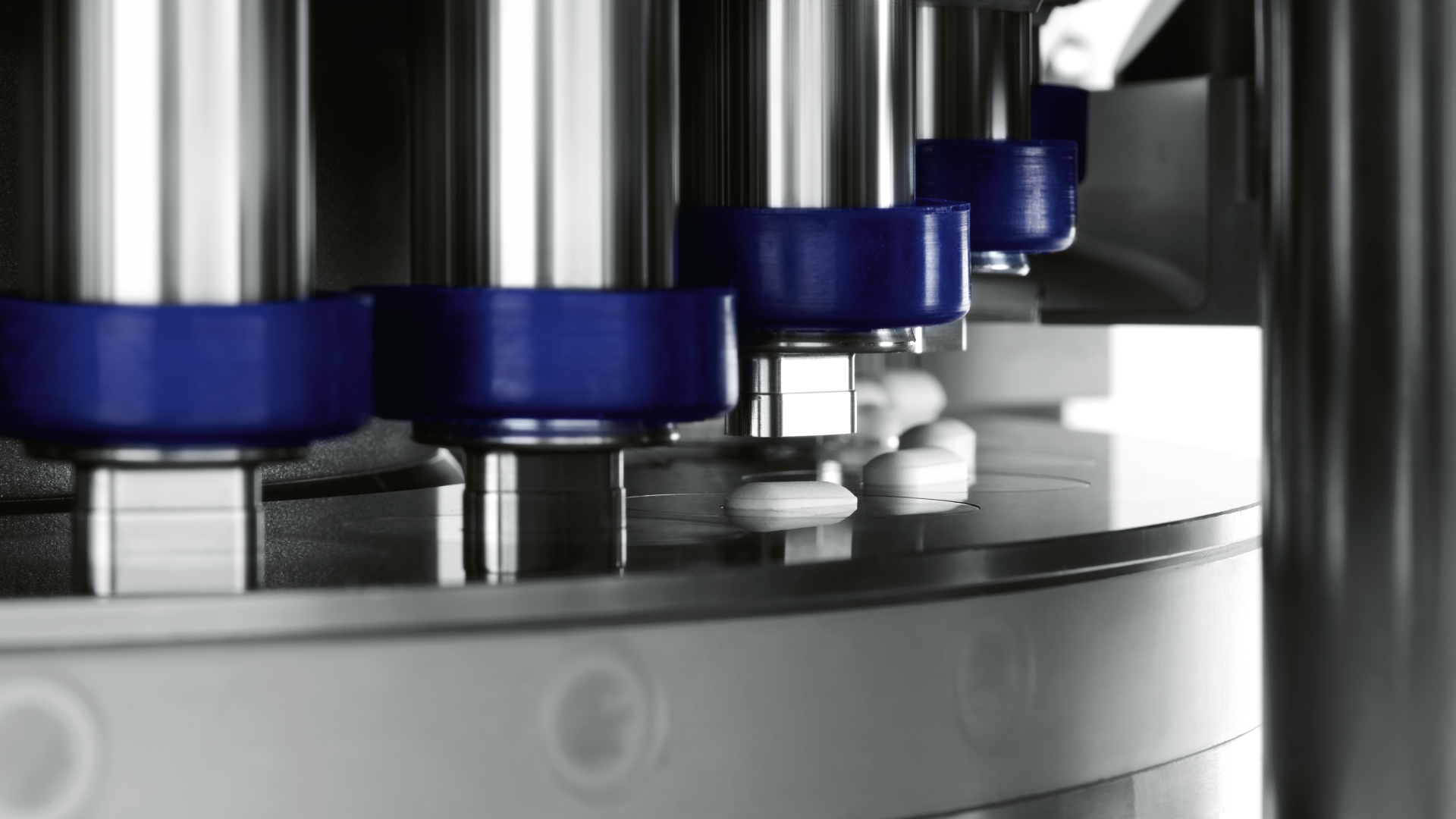
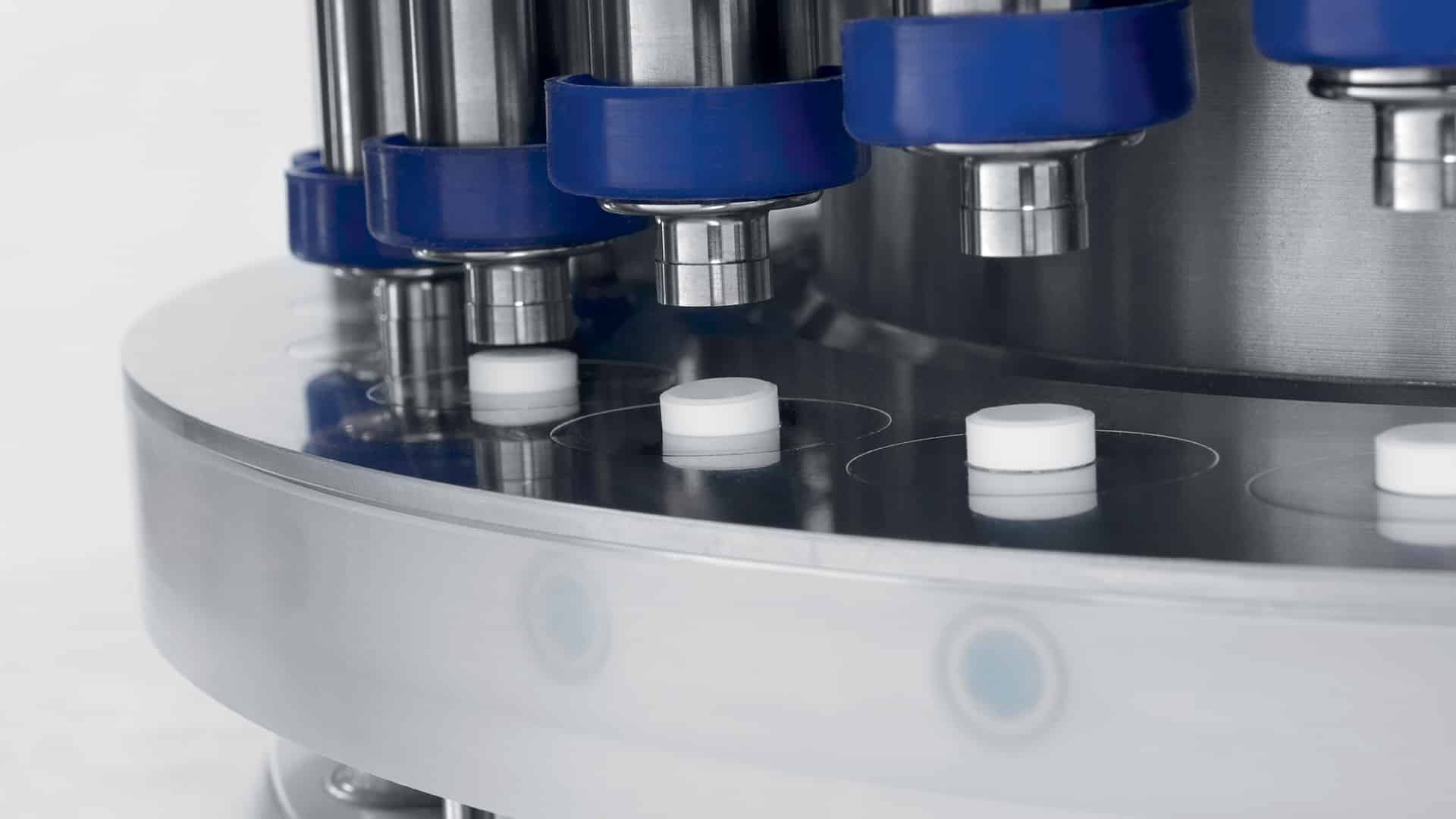
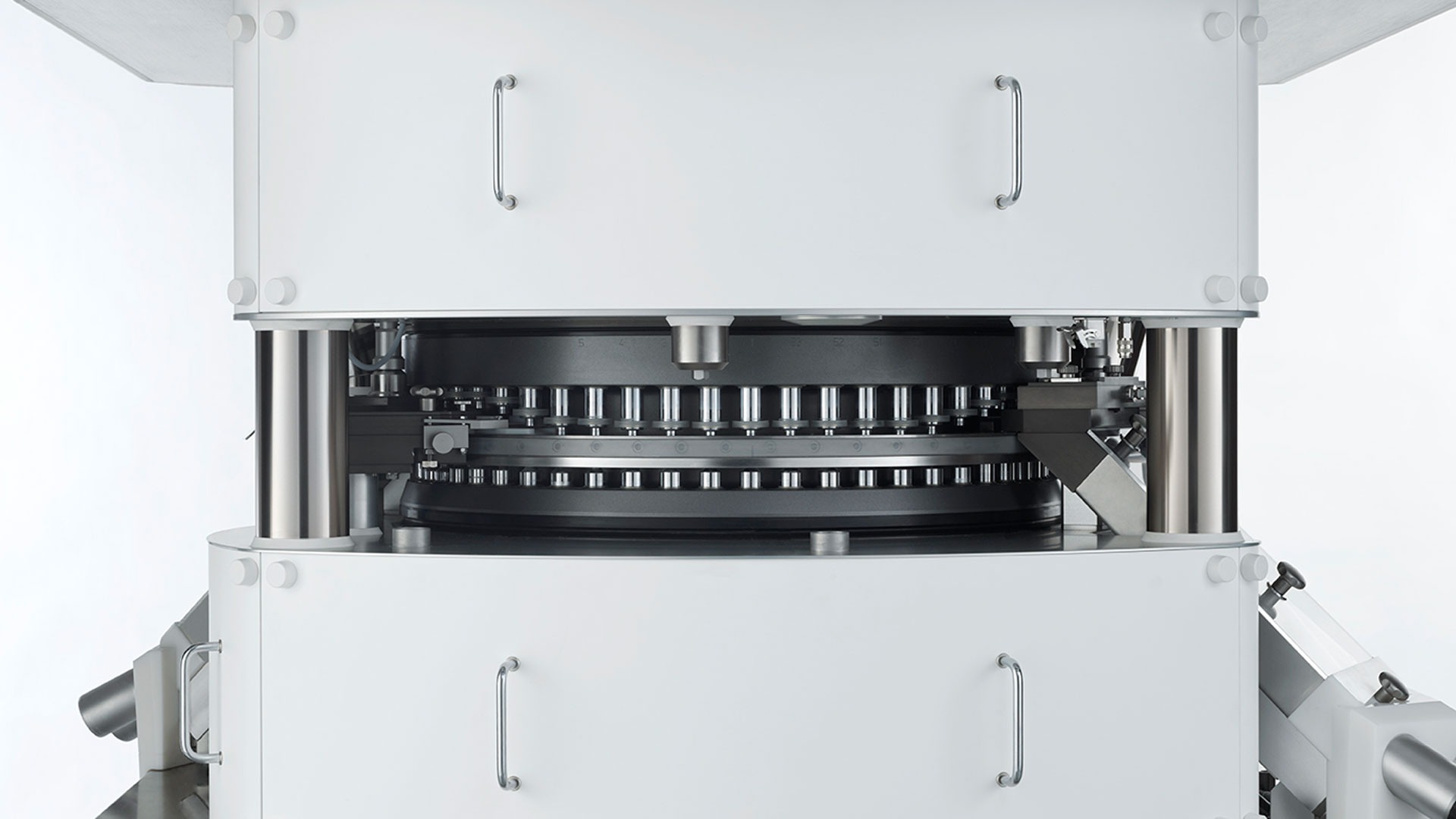
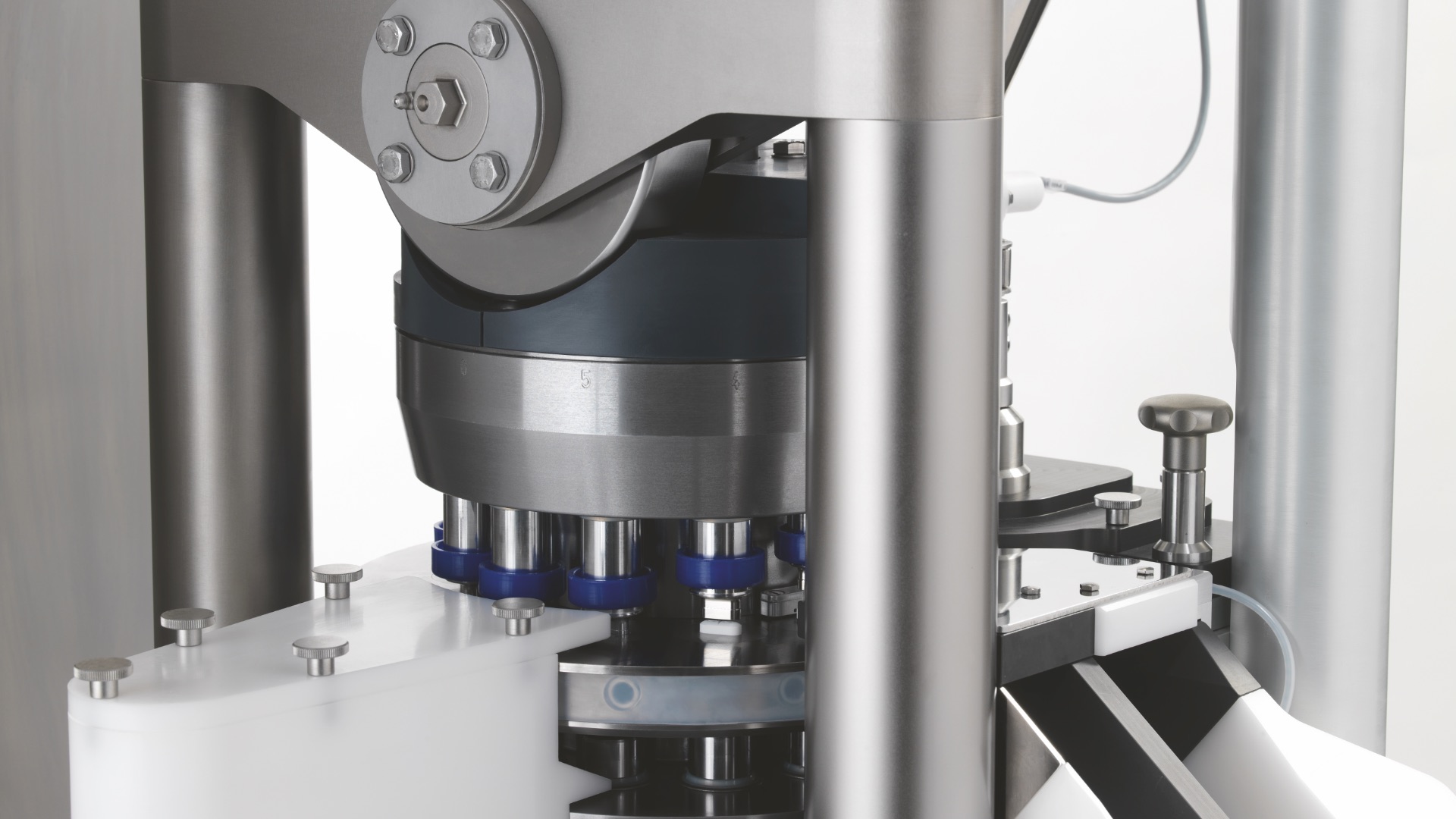
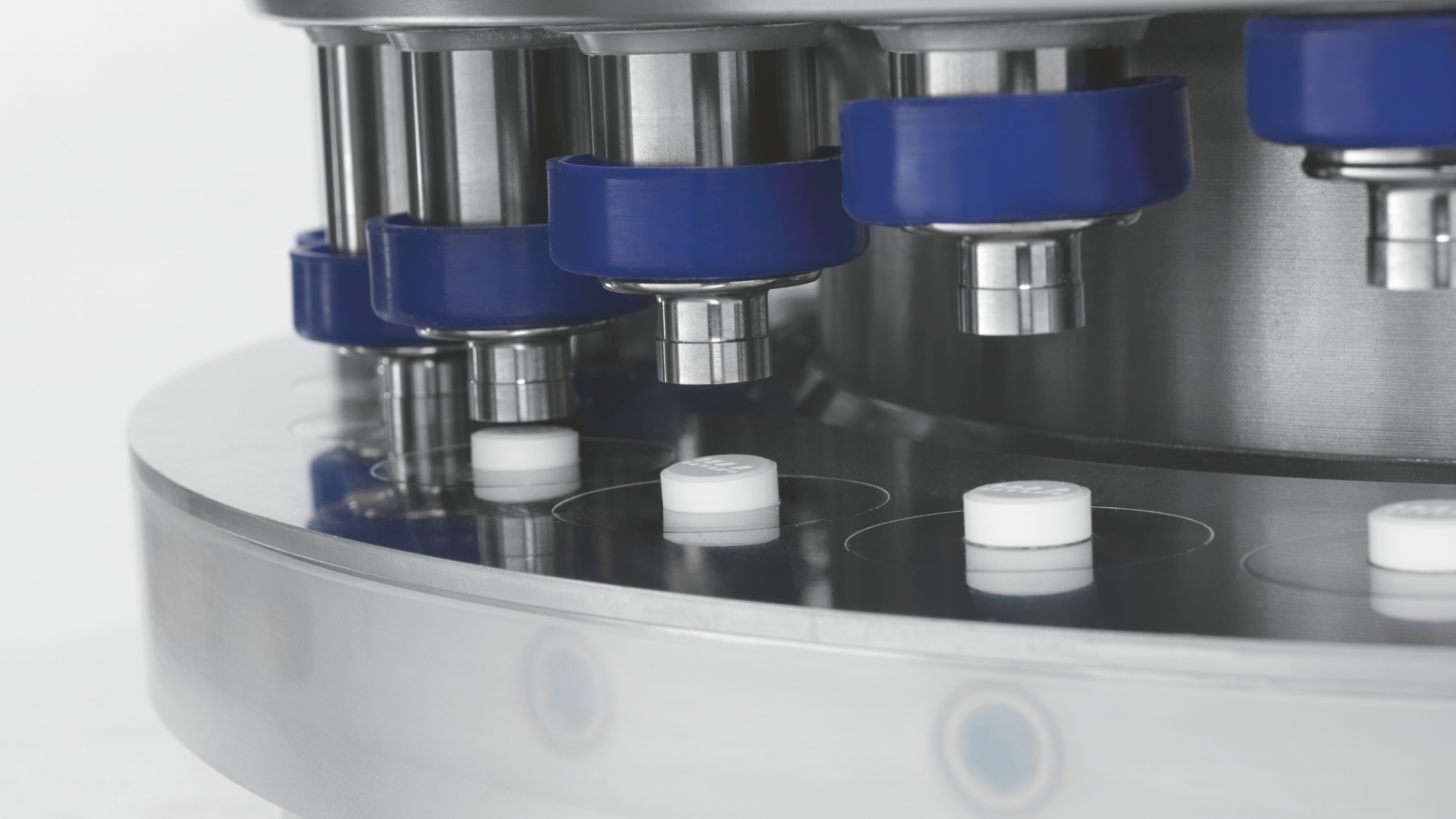
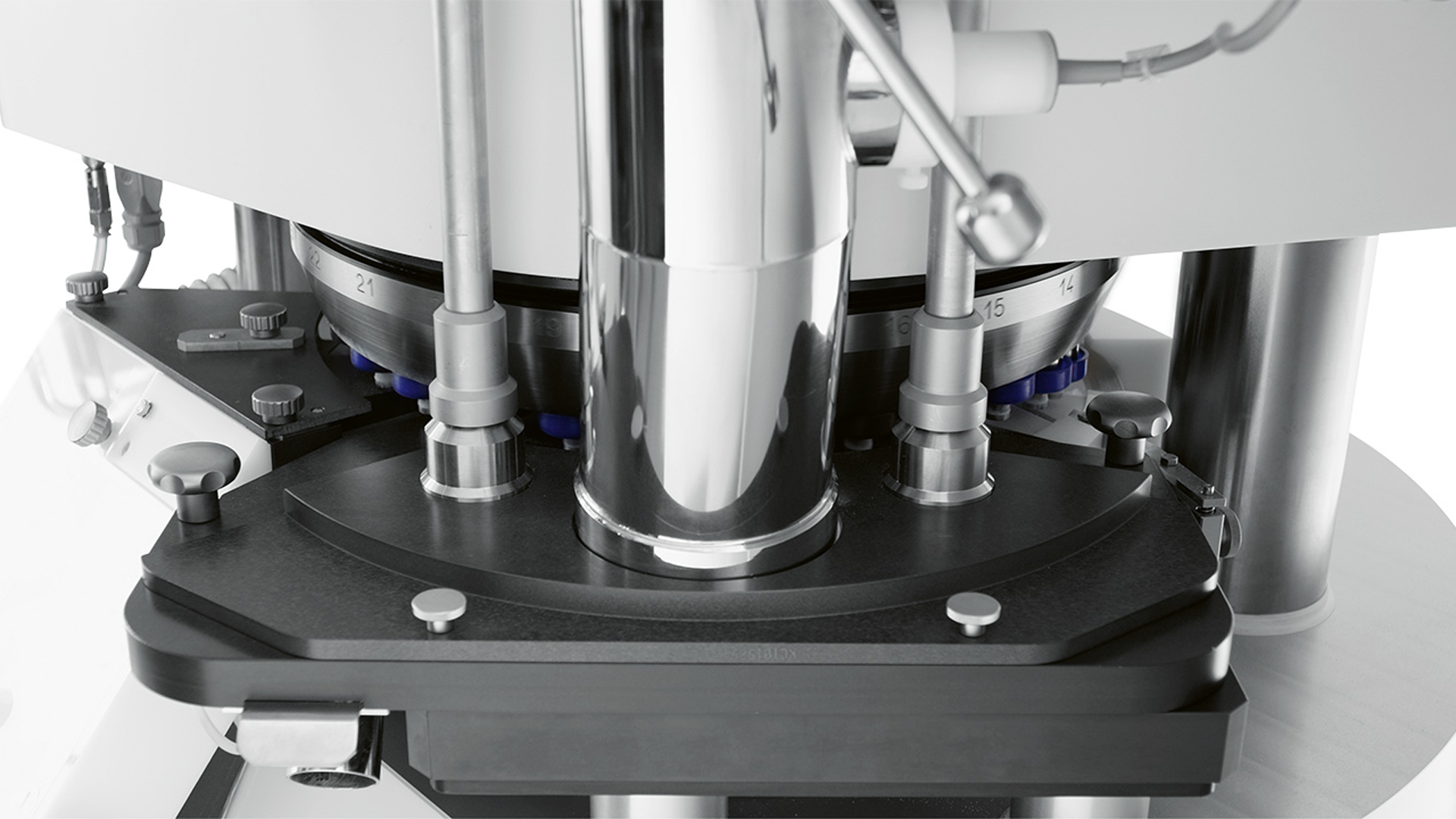
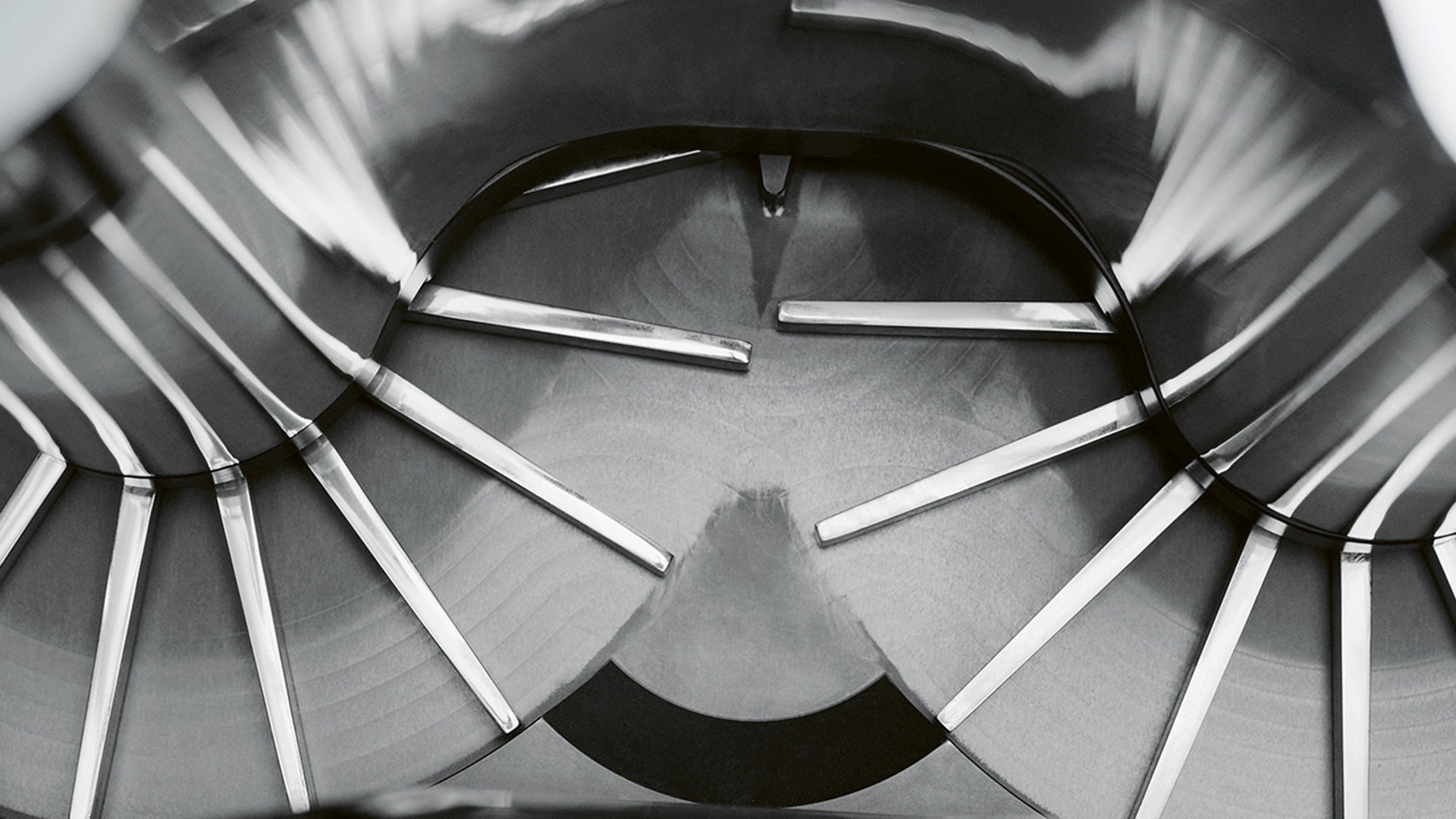
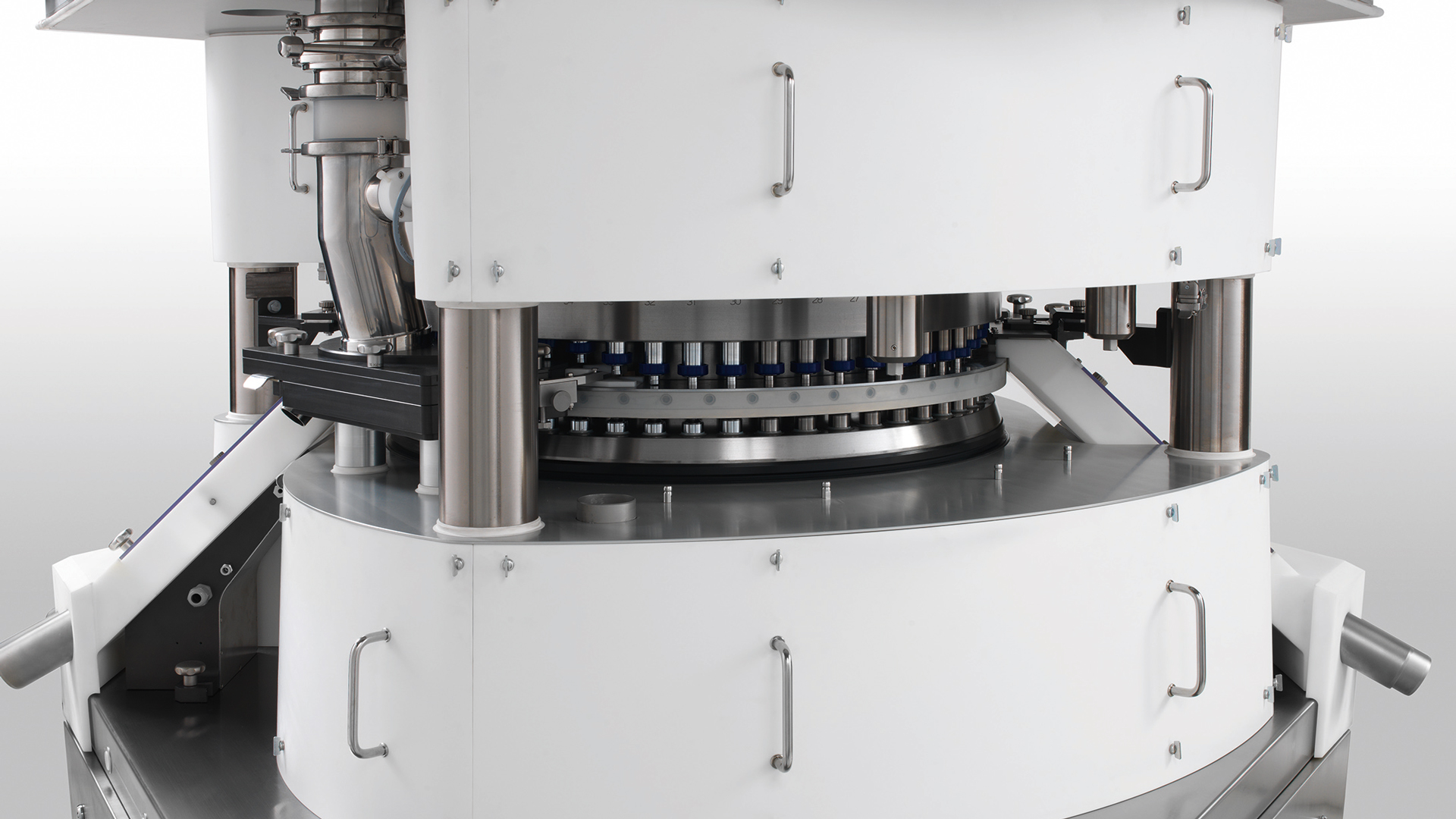
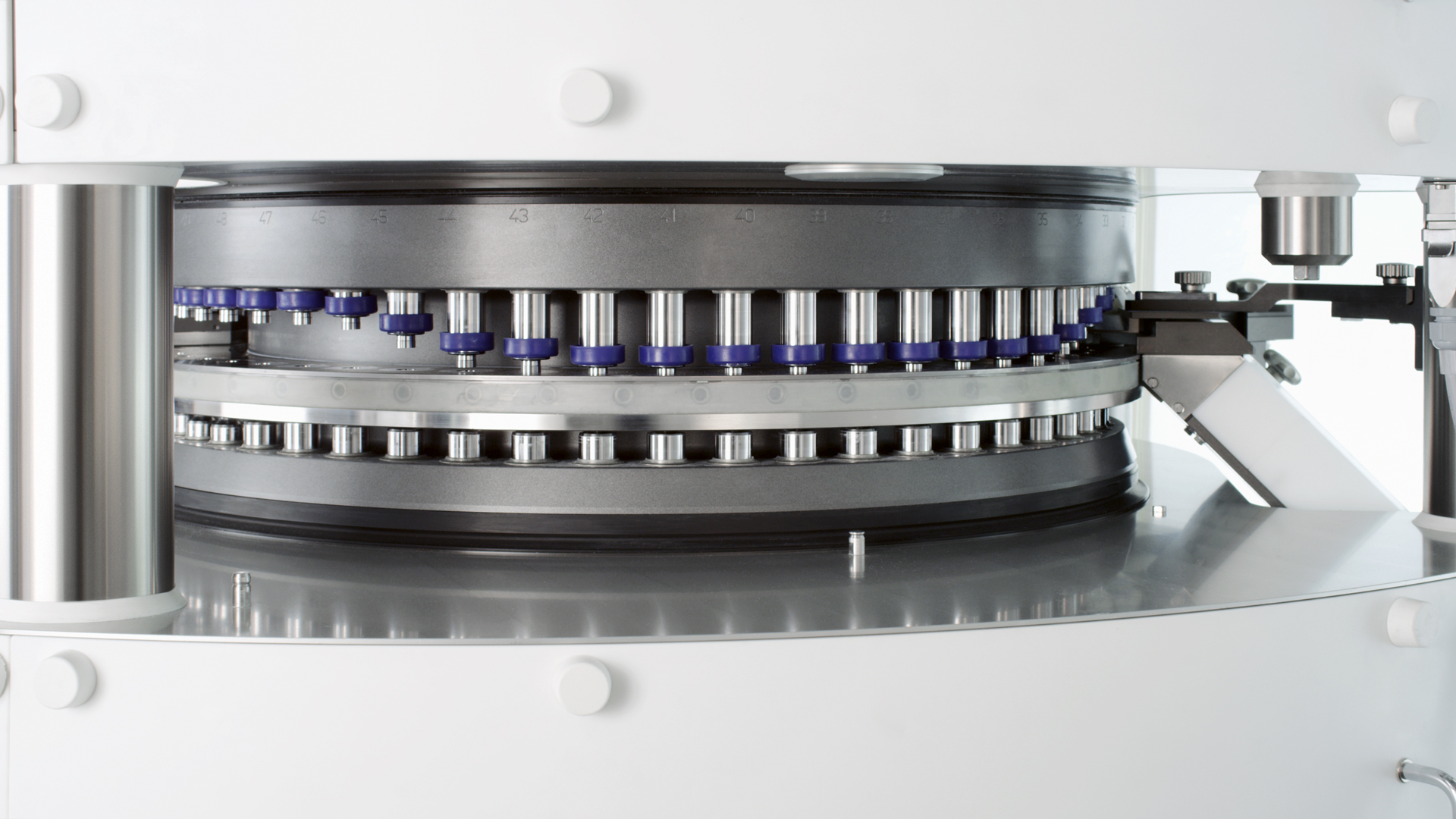
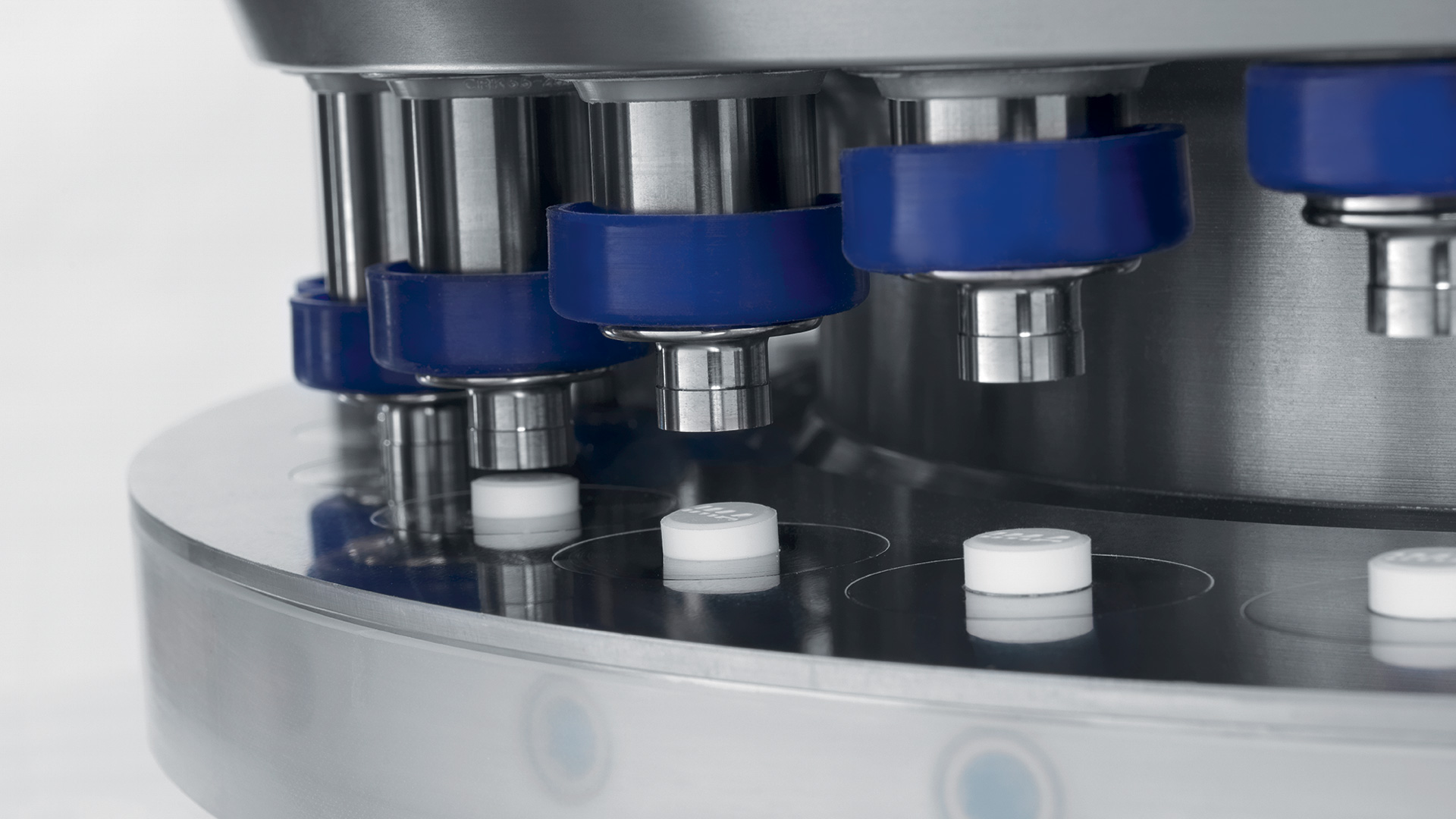
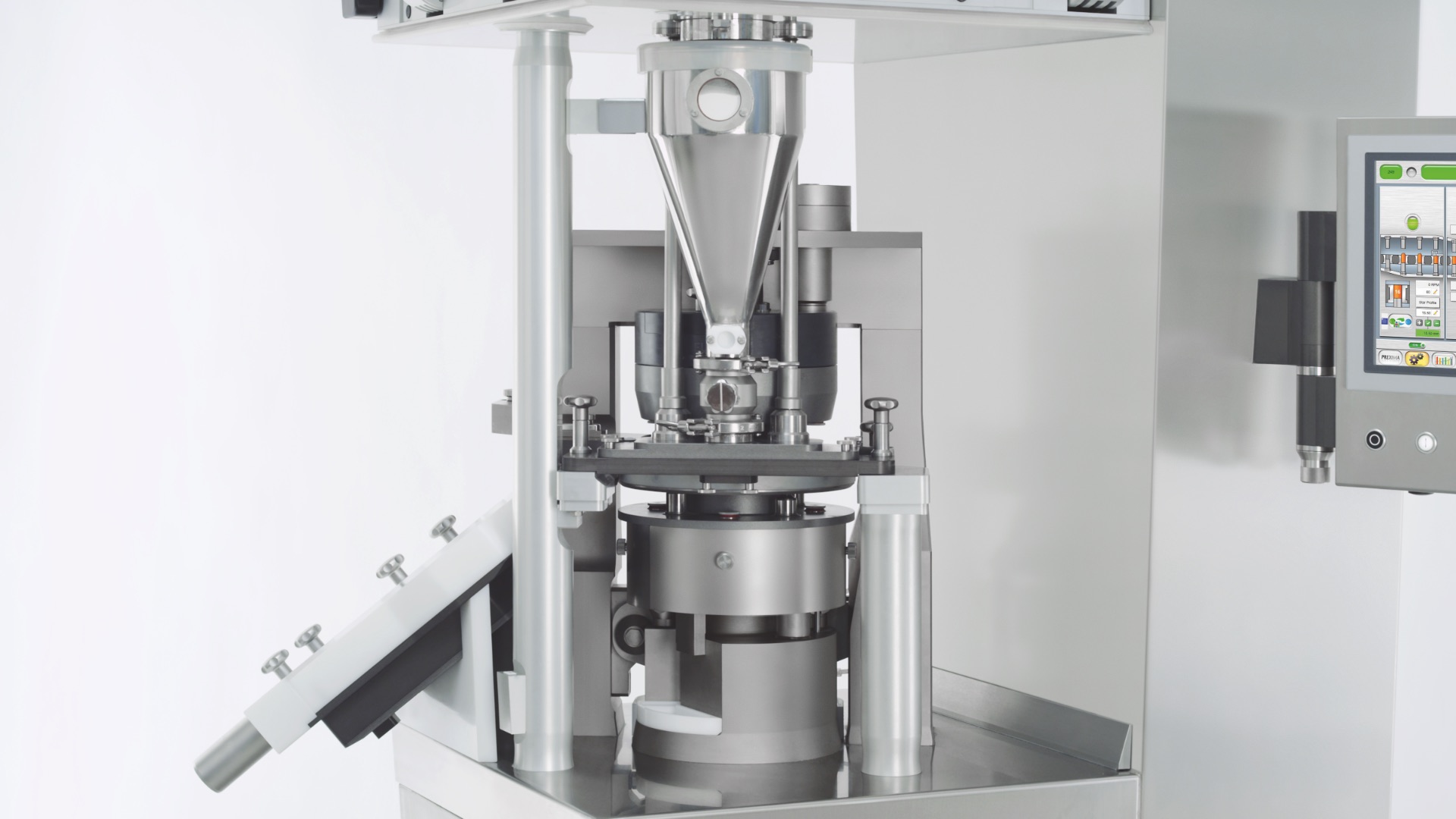
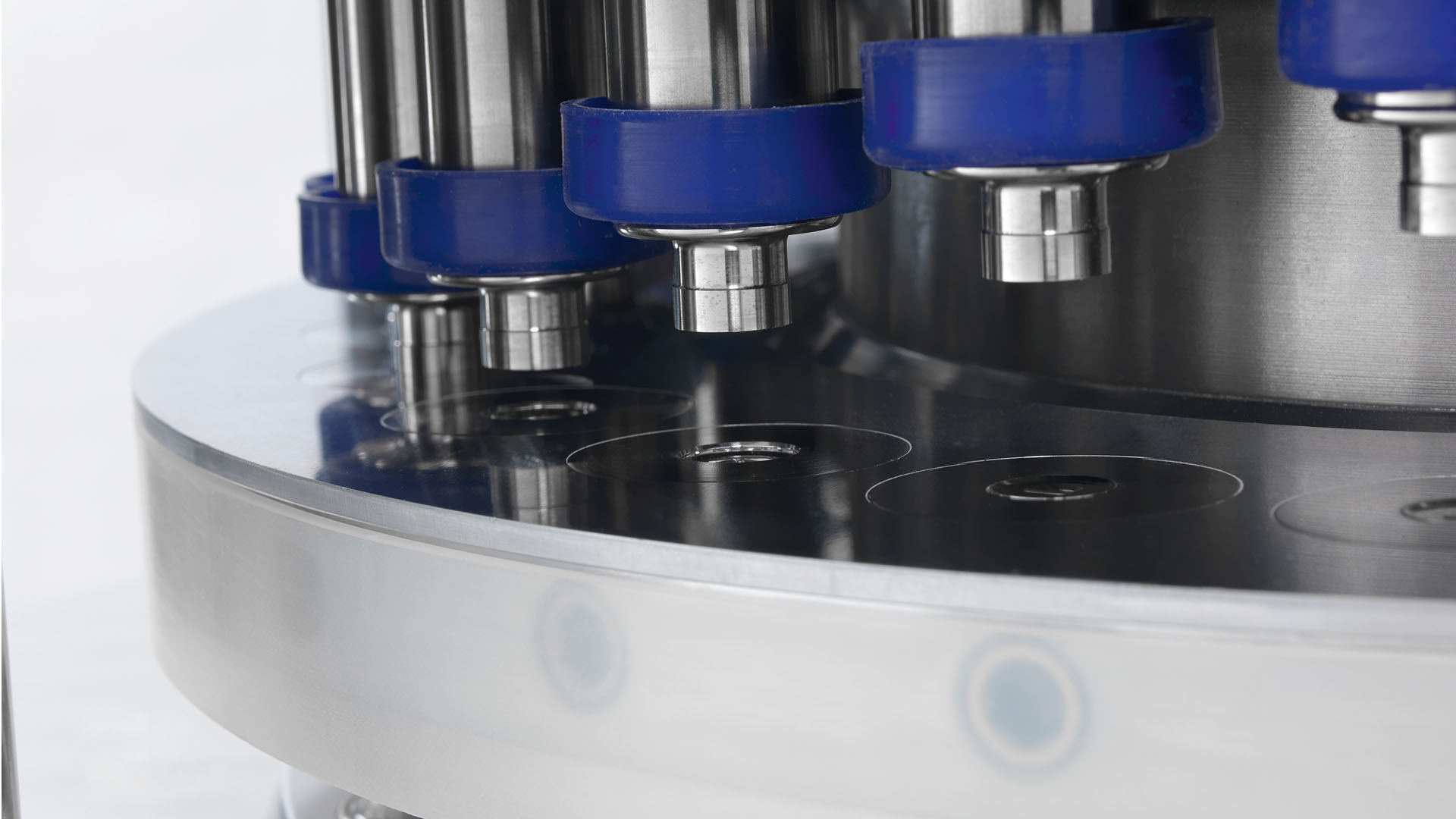
The tablet press plays a decisive role within a Continuous Direct Compression line. While dosing and blending establish the conditions for steady-state operation, it is at the press that all upstream design choices converge into measurable, real-time performance. In this sense, the tablet press becomes the final verification node of the entire process: it receives the stabilised powder flow, monitors its behaviour and ultimately determines whether the system remains within the desired state of control. Among IMA’s technologies, DOMINA plays a significant role: a press engineered to deliver the stability, precision and integration required for continuous processing. DOMINA in a CDC line is fed by a continuous duct that conveys powder directly to the feed frame. The rotating paddles inside the feed frame maintain powder mobility for uniform die filling. This design enables stable performance even during long continuous runs. The tablet press therefore becomes the point at which the upstream dosing and blending stability is confirmed in real time.
The tablet press in a continuous line is also where PAT tools — particularly MicroNIR — deliver their maximum value. Positioned just before compression, NIR interrogates the powder while it is still in a mobilised and homogeneous state. This gives a more reliable reading than attempting to scan finished tablets, which present variable orientations, surface irregularities and limited optical penetration.
By measuring the chemical nature of the blend just before tableting, NIR adds a layer of assurance that conventional controls (weight, force, thickness) cannot provide alone. When combined, a selective rejection is established: the system isolates everything that could have been affected, preserving continuity while protecting quality.
Conclusions
Two decades of regulatory maturation — from the 2004 PAT Framework to ICH Q13 — have removed the main formal obstacle to Continuous Direct Compression adoption. What remains is largely organisational: a shift from Quality by Testing to Quality by Design. IMA’s approach, built around MAESTRO’s supervisory layer and DOMINA’s feed-frame NIR verification, is designed to make this shift operable on the plant floor rather than confined to a development laboratory.
References
[1] https://www.fda.gov/regulatory-information/search-fda-guidance-documents/pat-framework-innovative-pharmaceutical- development-manufacturing-and-quality-assurance
[2] https://www.fda.gov/about, fda/center, drug, evaluation, and, research, cder/graduated, etp, technology
[3] https://www.fda.gov/about-fda/center-drug-evaluation-and-research-cder/graduated-etp-technology
[4] https://www.fda.gov/regulatory-information/search-fda-guidance-documents/q13-continuous-manufacturing-drug- substances-and-drug-products
[5] https://database.ich.org/sites/default/files/ICH_Q13_Step4_Guideline_2022_1116.pdf [6] https://www.ema.europa.eu/en/ich-guideline-q13-continuous-manufacturing-drug-substances-and-drug-products- scientific-guideline
White paper
Effervescent tablet processing and packaging: why integrated lines are shaping the future.
6 min
Brands: IMA S.p.A. – Active Division, IMA Active
6 min
Brands: IMA Active, IMA S.p.A. – Active Division
11 min
Brands: IMA Active, IMA S.p.A. – Active Division
White paper
ARCA: AI Root Cause Analysis.
8 min
Brands: IMA Active, IMA S.p.A. – Active Division
5 min
Brands: IMA Active, IMA S.p.A. – Active Division
13 min
Brands: IMA S.p.A. – Active Division, IMA Active
7 min
Brands: IMA S.p.A. – Active Division, IMA Active
12 min
Brands: IMA S.p.A. – Active Division
11 min
Brands: IMA Active, IMA S.p.A. – Active Division
Case study
Vitabalans Oy chooses PREXIMA.
4 min
Brands: IMA Active, IMA S.p.A. – Active Division
White paper
The Energy Diary: powering sustainability.

6 min
Brands: IMA Active, IMA S.p.A. – Active Division
12 min
Brands: IMA Active, IMA S.p.A. – Active Division
8 min
Brands: IMA S.p.A. – Active Division, IMA Active
10 min
Brands: IMA S.p.A. – Active Division, IMA Active
10 min
Brands: IMA Active, IMA S.p.A. – Active Division
14 min
Brands: IMA Active, IMA S.p.A. – Active Division
12 min
Brands: IMA S.p.A. – Active Division, IMA Active
11 min
Brands: IMA Active, IMA S.p.A. – Active Division
Case study
Mastering tablet manufacturing: how segment tools improve productivity, efficiency and consistency.
7 min
Brands: IMA Active, IMA S.p.A. – Active Division
34 min
Brands: IMA Active, IMA S.p.A. – Active Division
8 min
Brands: IMA Active, IMA S.p.A. – Active Division
White paper
Comparison of minitablets and pellets as multiparticulate drug delivery systems for controlled drug release.
24 min
Brands: IMA Active, IMA S.p.A. – Active Division
Case study
Lubricant sensitivity of direct compression grades of lactose in continuous batch tableting process.
33 min
Brands: IMA Active, IMA S.p.A. – Active Division
5 min
Brands: IMA Active, IMA S.p.A. – Active Division
9 min
Brands: IMA Active, IMA S.p.A. – Active Division
7 min
Brands: IMA Active, IMA S.p.A. – Active Division
14 min
Brands: IMA Active, IMA S.p.A. – Active Division
11 min
Brands: IMA Active, IMA S.p.A. – Active Division
8 min
Brands: IMA Active, IMA S.p.A. – Active Division

8 min
Brands: IMA Active, IMA S.p.A. – Active Division
Case study
Formulation development of Vitamin C based effervescent blend suitable for direct compression.
8 min
Brands: IMA Active, IMA S.p.A. – Active Division
7 min
Brands: IMA Active, IMA S.p.A. – Active Division
7 min
Brands: IMA Active, IMA S.p.A. – Active Division
13 min
Brands: IMA Active, IMA S.p.A. – Active Division
White paper
Autoregulation function on DOMINA tablet press.
6 min
Brands: IMA Active, IMA S.p.A. – Active Division
Case study
IMA and OSIsoft: setting the standard in tablet press process data to accelerate production set-up.

4 min
Brands: IMA S.p.A. – Active Division, IMA Active
10 min
Brands: IMA Active, IMA S.p.A. – Active Division
Case study
Power to the essential.
6 min
Brands: IMA Active, IMA S.p.A. – Active Division
6 min
Brands: IMA Active, IMA S.p.A. – Active Division
7 min
Brands: IMA Active, IMA S.p.A. – Active Division
5 min
Brands: IMA Active, IMA S.p.A. – Active Division
5 min
Brands: IMA Active, IMA S.p.A. – Active Division
White paper
Preliminary results of predictive maintenance algorithms on a tablet press production machine.
7 min
Brands: IMA Active, IMA S.p.A. – Active Division
White paper
The Prexima challenge. Comparison of rotary tablet presses seminar in Leverkusen (Germany).
8 min
Brands: IMA Active, IMA S.p.A. – Active Division
6 min
Brands: IMA Active, IMA S.p.A. – Active Division
Case study
Directly compressed minitablets coated in a solid wall pan for the sustained release of drugs.
6 min
Brands: IMA Active, IMA S.p.A. – Active Division
5 min
Brands: IMA Active, IMA S.p.A. – Active Division
7 min
Brands: IMA Active, IMA S.p.A. – Active Division
7 min
Brands: IMA Active, IMA S.p.A. – Active Division
7 min
Brands: IMA Active, IMA S.p.A. – Active Division
White paper
How to perform a good scale-up.
5 min
Brands: IMA S.p.A. – Active Division, IMA Active
White paper
Salty compression.
4 min
Brands: IMA Active, IMA S.p.A. – Active Division

4 min
Brands: IMA Active, IMA S.p.A. – Active Division
4 min
Brands: IMA Active, IMA S.p.A. – Active Division
6 min
Brands: IMA Active, IMA S.p.A. – Active Division
7 min
Brands: IMA Active, IMA S.p.A. – Active Division
Case study
Tableting at its best.
5 min
Brands: IMA Active, IMA S.p.A. – Active Division
Case study
BMP: «PREXIMA fits all our needs».
4 min
Brands: IMA Active, IMA S.p.A. – Active Division