Step into Cognitive Manufacturing
Where data becomes intelligence.
And intelligence becomes action.
What is Cognitive Manufacturing?
Cognitive Manufacturing is the evolution of manufacturing from connected machines to coordinated production ecosystems. It brings together operators, industrial equipment, artificial intelligence, robotics and software platforms into a single environment that continuously supports and improves production performance.
Today, production machines generate enormous amounts of information. Every operation, every product, every process condition and every interaction across the line creates valuable data. Yet data alone does not improve performance unless it can be transformed into faster decisions, better coordination and more effective actions on the factory floor.
This is where Cognitive Manufacturing makes the difference.
By connecting machines, production lines, vision systems, robots, software applications and human expertise, it creates an environment where information flows continuously across the manufacturing ecosystem. Operators gain greater visibility, machines become easier to manage, and production teams can react more quickly to changing conditions.
Artificial Intelligence plays an important role within this ecosystem, but the real intelligence of a production system comes from the combination of human expertise, operational knowledge, machine capabilities and data-driven insights.
AI contributes by analysing information, identifying patterns, detecting anomalies and recommending actions, while production objectives, operational priorities and final decisions remain defined, governed and supervised by people.
As a machine manufacturer and system integrator, IMA combines machines, automation, robotics, vision technologies, software platforms and AI-enabled services into integrated production ecosystems tailored to each customer’s needs. This approach transforms disconnected production assets into coordinated systems where information, processes and resources work together to support operational excellence, flexibility and continuous improvement.
The result is not simply smarter machines, but an ecosystem where machines, people and technologies work together more effectively, continuously sharing information, adapting to change and supporting production performance, operational flexibility and continuous improvement.
Cognitive Manufacturing extends human expertise across the entire manufacturing ecosystem, enabling people, machines and technologies to perform at their best together.
From connected machines to coordinated decisions. From isolated automation to integrated manufacturing intelligence.
A new approach that will bring tangible impact
in everyday production.
-
Reduced downtime
Identify anomalies before failures occur and reduce unplanned production interruptions through predictive monitoring.
Potential impacts
• Lower maintenance costs
• Increased equipment availability
• Higher production continuity -
Increased productivity
Optimize machine performance and production workflows using real-time operational insights.
Potential impacts
• Higher throughput
• Better resource utilisation
• Improved OEE -
Improved quality
Detect process deviations earlier and support consistent product quality across production batches.
Potential impacts
• Reduced waste
• Increased compliance
• Fewer production defects -
Faster decision-making
Transform large volumes of data into clear recommendations and actionable insights.
Potential impacts
• Faster response times
• Better operational visibility
• More informed business decisions -
Energy & resource optimization
Monitor and optimize resource consumption across production processes.
Potential impacts
• Lower energy costs
• Improved sustainability performance
• Increased operational efficiency
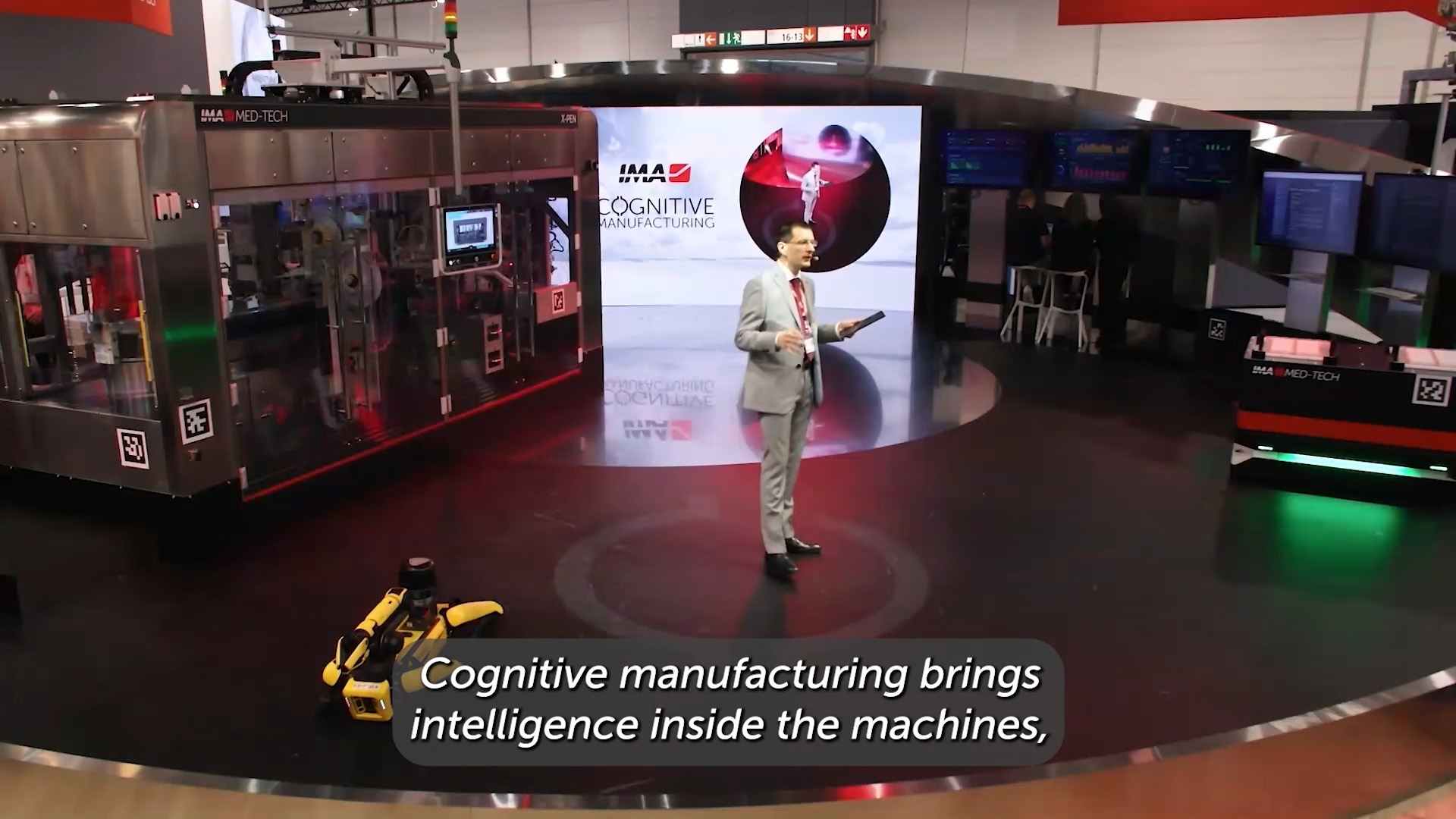
Cognitive Manufacturing
in 90 seconds
Cognitive Manufacturing uses AI to empower human decision-making and operational control, transforming data into real-time intelligence that helps coordinate machines, robots and digital systems in support of human-defined production goals, while continuously adapting to changing conditions and operational events.
Cognitive Manufacturing
Architecture & Structure
In a cognitive manufacturing environment, data collected from machines and vision systems is transformed into actionable intelligence that supports operators and production teams in achieving their objectives. AI analyses, correlates and orchestrates this information, helping people make informed decisions and enabling robots and automated systems to execute optimized actions in real time.
The resulting operational data is continuously fed back into the system, creating a closed-loop learning environment where technology and human expertise continuously reinforce each other. This is what makes manufacturing “cognitive”: not autonomous technologies acting independently, but people, machines and digital systems continuously learning, adapting and improving together.
FAQ
Decisions Flow
Manufacturing generates vast amounts of information every day. The challenge is not collecting data. The challenge is transforming it into value. Through Cognitive Manufacturing, IMA converts machine data into meaningful insights that support maintenance teams, production managers and business leaders in making faster and more confident decisions.
-
Step 1
Collect data from connected machines
and production systems. -
Step 2
Analyze operational patterns
using AI-powered intelligence. -
Step 3
Detect opportunities,
anomalies and risks. -
Step 4
Provide actionable recommendations
and decision support. -
Step 5
Activate robotics to improve performance
under human supervision.