Case study
INJECTA. Fill-finish Solutions for Flexible and Multi-product Manufacturing
-
Reading time 8 min
-
A study by
IMA Life
Filling and Closing Machines for RTU Syringes, Vials and Cartridges
Introduction
The growing market trend for pre-filled syringes and other Ready-To-Use components is strictly connected to the high prevalence of chronic diseases across the globe, the increase in the geriatric segment of the population, more sedentary lifestyles, the growing use of safety self-administration devices and the rising demand for vaccines.
On the other hand, the ongoing biopharmaceutical boom (biologic and biosimilar drugs) has also contributed to an increase in products targeted for parenteral delivery, which, in turn, has contributed to promoting the growth of the pre-filled syringe market, as pre-filled syringes are easy to use and ensure a high dosing accuracy while minimizing product loss. Companies targeting biologics face a new frontier in development and manufacturing as these drugs are targeted for smaller patient populations and are difficult to produce owing to the reactivity, viscosity and expense of the macromolecules.
Being patient safety and dosing accuracy the main issues for injectable administration, flexible and multi-product fill-finish operations are becoming more crucial as most of the new injectables require a delivery model that is patient-centric, safe and cost effective. Biologics and biosimilars are more process-intensive and the traditional aseptic process is not well suited to meet the need for medium-to small batch flexibility. Their complexity, as well as their advanced formulation (high-value drugs) change the way products are brought to the market and companies are now looking to reduce the total cost of production, which is higher in relation to pharma drugs.
Today’s challenge for manufacturing companies is to adopt new methods and technologies to process high-value drugs with high-mix batches into multiple formats or sizes (such as vials, cartridges and syringes for parenteral use) so as to ensure a flexible and repeatable process, in a controlled, safe environment. The process must be repeatable and minimize the risks, so as to reduce contamination potential and improve production quality and manufacturing efficiency in an aseptic and sterile fill-finish process. The growing use of a closed robotic filling system is in response to these changes and demands!
Robotic revolution and isolator-barrier systems: the perfect combination for advanced aseptic processing.
Meeting this growing demand for multi-product, fill-finish operations, IMA Life has designed and implemented a flexible and reliable “medium-to-low production batch” scalable solution for the filling and closing of a wide range of Ready-To-Use (RTU) disposable components:
Injecta, our ultimate, fully robotic fill-finish machine for RTU components pre-arranged in nest & tub or trays.
Injecta is our innovative approach to deliver a new aseptic filling machine concept for injectable pharmaceuticals. Its Quality By Design (QbD) development process has been outlined to meet the targeted product quality profile and operate in a faster, safer way, so as to proactively respond to the challenges posed by the increasing complexity of new drug substances (medium-to-small batch flexibility). To achieve the best possible improvement in terms of safety and productivity, INJECTA’s full fill-finish process is based entirely on robotics operating in a closed, “towards gloveless”, isolator environment.
In aseptic processing, operators are the primary source of contamination. INJECTA is designed to run with no mouse holes, conveyors, glass-to-glass contact or vibrating bowls which all create risks to the batch. Results: cost and time saving, major safety for operators and, thanks to the isolator environment, an increase in product quality and safety.
Whereas conventional attempts to use robots are typically confined to just one step of production, i.e. simply for moving vials from station to station or for removing the cover from a tub of nested containers, INJECTA uses the full potential of its robots.
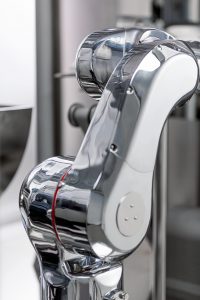
Its specialised robots perform all handling activities with no glass-to-glass contact and without operator intervention. INJECTA is designed as a whole, exploiting all robotic capabilities in an integrated system. Kawasaki’s seven-axis robot arms are manufactured for the lowest degree of particle shedding.
They are resistant to positive/negative and high pressures and fully compatible for decontamination using H2O2 vapours. No human intervention is required: all activities/issues are solved through robot interactions.
INJECTA’s specialised robots not only provide precise, consistent handling activities, but also offer a high level of flexibility: they are completely digitally controlled with Industry 4.0 capability, thus allowing a better understanding of the manufacturing processes while meeting quality standards and increasing efficiency (integrated automation platform to drive knowledge/information and promote data-driven decision-making).
Injecta basis of design is hinges on the following 4 main key-concepts:
Flexibility:
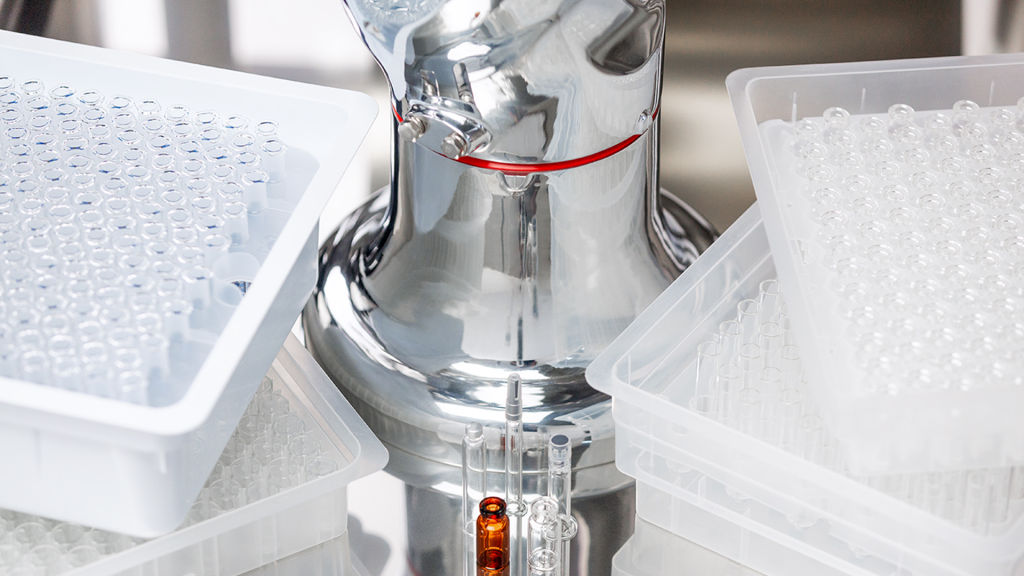
- Multi-product and multi-format handling: INJECTA handles pre-sterilised Ready-To-Use containers (syringes, vials or pre-capped cartridges), pre-oriented vials in trays as well as sterilised vials from the depyrogenation tunnel, allowing high process flexibility and adaptability. No need to change the filling module thanks to rapid switches between different drugs and primary packaging products.
- Robotic Technology: the use of advanced robotically driven manipulations throughout all production operations, from outer/inner bag opening to the stoppering station allows for a very smooth production process, drastically reducing human interventions and cross-contamination risks.
Modularity:
- INJECTA in-built modular configuration (available from 1 up to 10 filling nozzles) guarantees a comprehensive, contained integrated production system with no use of interchangeable production modules to adjust production processes. Injecta is flexible and precise in terms of quality.
Its design is intrinsically modular and meets multiple requirements from small-scale clinical trial batches up to medium-high production levels. - High versatility in product handling: the RTU CONTAINERS can be accurately and efficiently filled and closed INSIDE A NEST OR BY DE-NESTING OPERATIONS. The robotised individual component handling solution (i.e. de-nesting configuration) is ideal for high-level quality control requirements.
- Highest adaptability for multiple lay out solution and shapes: INJECTA is fit for multiple lay out solutions/requirements: IN-LINE or T-SHAPE LYO configurations, ALL-IN-ONE INTEGRATED FILL-FINISH SOLUTION with combined lyo process and capping operations, dedicated solutions to process RTU vials FROM BULK OR upside down from TRAYS. INJECTA’s production modules (primary package handling, filling, stoppering, loading&unloading and capping modules) can be easily fitted and assembled in various configurations (not only the horizontal standards).
Enhanced quality:
- Innovative bag and tub opening: to meet the regulatory requirements, the whole tub opening unit is completely robotized and under containment. After cutting the bag overwrapped around the tub, the primary package is instantly transferred by an internal transfer port to the isolated, processing area. To preserve the sterility of the tub, the bag flaps are opened by the suction cups, only when the tub is physically transferred to the isolated area.
- Gloveless ready: the production flow of the fill-finish process is completely gloveless, so as to improve protection and minimize cross-contamination risks. INJECTA is perfectly integrated with IMA Life’s isolator with reduced shell width. The presence of gloves is minimized around the filling & stoppering “isles”.
- Advanced compliance: the stoppering process is performed using a linear stopper feeding system. Unlike conventional systems, this innovative group is made of small-sized components ideal for RTP transfer, in compliance with Annex 1 requirements in terms of sterilisation process. An innovative fully robotized system for stopper unit collection & assembly is available as well.
- 100% in-line process: INJECTA is naturally born to be flexible. It can easily combine and perform a fully robotized 100% IPC both while in-nest and in de-nesting configurations. As a de-nesting solution, INJECTA’s flexible handling units allow for precise removal of the components from the nest. As a result, individual components are filled, check-weighed, stoppered and then replaced into the nest, in case of syringes and cartridges, or transferred by a conveyor belt to complete the process
Business drivers:
Single rejection from the nest or with de-nesting: all processed RTU components are individually check-weighed (in case of de-nesting) or check-weighed all together while in nest, with single rejection of each individual non-conformity, safeguarding the nest.
Scalable design: unique production platform (from one up to ten filling pumps) performing the same identical product handling, filling and stoppering operations avoiding any additional production process re-qualification with consequent time-to-market reduction.
Conclusions
In conclusion, the intensive use of advanced robotically driven manipulations versus conventional handling systems saves process time and costs, thus improving product quality and manufacturing efficiency.
The result is “less time” spent validating aseptic conditions and superior agility for multi-product manufacturing: no size part changeover, rise of process capacity, minimization of product losses, reduced human intervention, smaller footprint. Pharmaceutical companies that move products to market faster will beat their competitors in an era that demands greater agility.